Always looking to get better

Category: Blog (Page 2 of 5)

Officially 10 Years Training – 2016-2019 – Experiencing a Whole New World

On a frigid Friday night in January of 2016 I was driving to New Jersey to get some gas when a strange phone number popped up. Those that know me know I’ve gotten plenty of strange calls in my life, but this one had a Miami area code. Unlike those other calls, this was actually a good one.

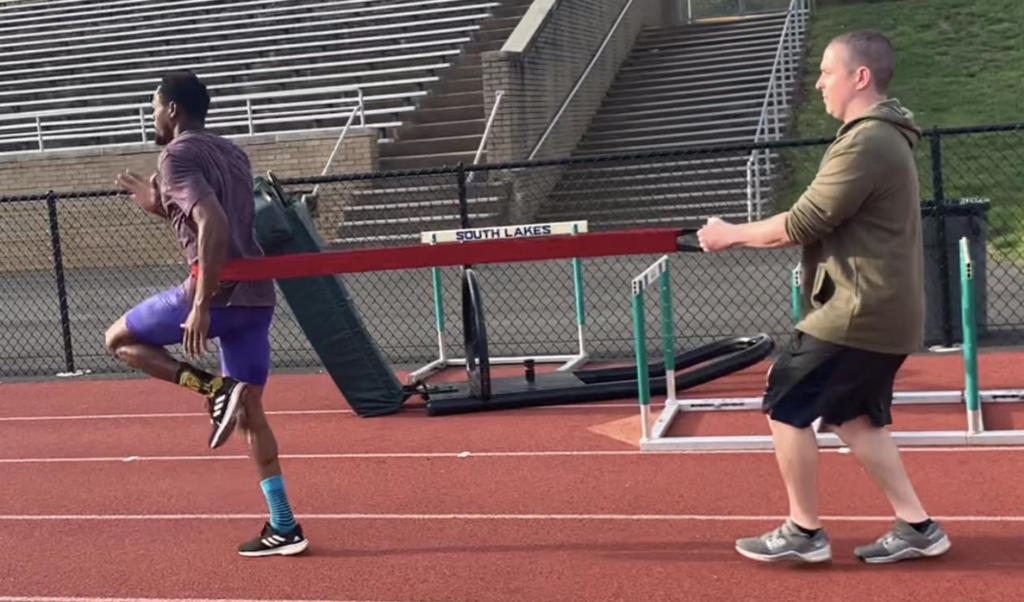
Justin Kavanaugh training former Navy QB Keenan Reynolds. Reynolds finished fifth in the Heisman Trophy race in 2015.

It was Justin Kavanaugh reaching out after I emailed him back after SWIS. I’ll be honest, I didn’t think he was ever going to reach out to me. He asked me if I wanted to come down during my February break to his facility in Virginia, the Sport and Speed Institute (SSI), to watch him train his guys for their NFL Pro Days and discuss some things to write about. When I left newspapers in 2013, I didn’t ever think writing would come into play again. Turns out, writing was instrumental in getting my foot in the door in both teaching and coaching.

I was down to check out this stranger’s gym, even though I had no idea what to expect. Little did I know, this trip would change the entire course of my coaching career. I was about to walk into a world that I only knew of from my time at SWIS. Without this phone call, I’m most likely not in the training business anymore. I would have eventually flamed out.

2016-to-2019 was a game-changing, four-year span for me. My knowledge and network would grow exponentially and my business would slowly go in the direction I wanted it to. Because so much happened, I broke it down into two posts. The next post will get into the business side because that doesn’t grow without all of the experiences that took place outside of Staten Island.

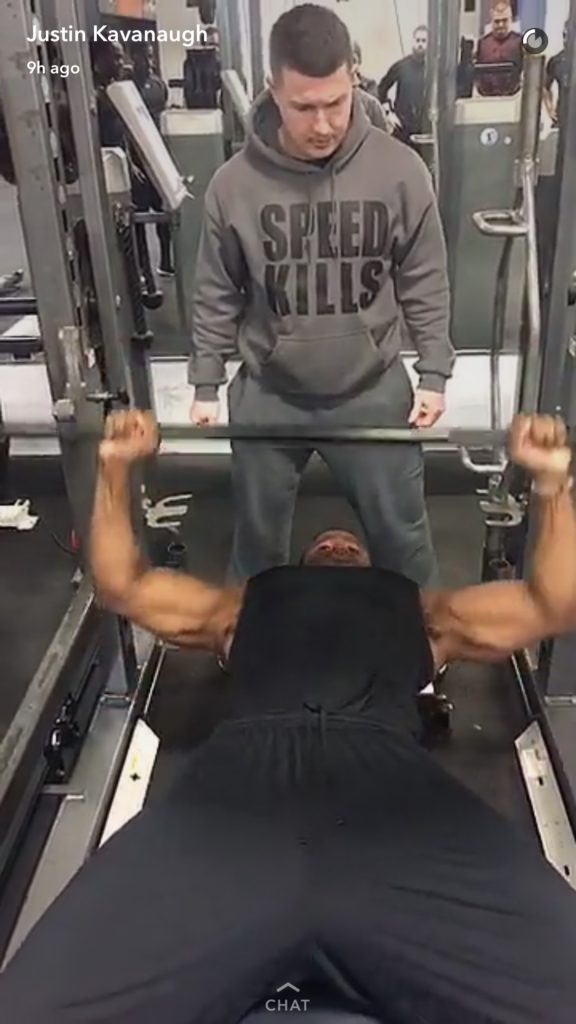
Spotting Trey Edmunds, who went on to play for the New Orleans Saints and Pittsburgh Steelers, during the 225 Bench Press Test.

That trip to Virginia during President’s Day Weekend, turned into another trip over the summer where I was humbled, to say the least, running my first speed session with 10 minutes notice, to experiences that would change my life. This is where I learned what true training is and learned about the things you can’t just find online. I went into that trip not knowing what I was getting into to leaving feeling that I was truly on the right track for the first time. There were glimpses here and there before, but this trip gave me hope because I believed I had someone in my corner that would show me the right way to do things. Right after that first trip, I used my winnings from the SB911 contest to attend the CPPS certification weekend.

Every year I went down I was exposed to NFL and Olympic training. I watched how Kav and Dylan Seeley (now he’s Dr. Dylan) worked with these guys for hours and saw real high-level coaching that you hear about, but never see. People that know Dylan now know that he’s one of the best. But I got to see him before he even graduated and he was already speaking and coaching at a level that few are able to. I also saw how sessions should be run from the youth through collegiate level from watching Allan Africa, Conner Crowell, Jon Lamb, Lars Stevenson (now he’s Dr. Lars), Thomas Mayhugh, Harrison Leep, Amy Driessen and Gabi Morrison coach. I was getting the chance to watch coaches who had experience playing their sport at the collegiate level or got to work in a collegiate setting coach athletes.

I got to watch Jason Rogers train for the Tokyo Olympics in 2019.

Every year I would be down at SSI during President’s Day break to watch him train his guys for their Pro Days. You have to be more than a spectator when you’re with Kav, so he gave me the opportunity to speak to his guys about dealing with the media and I’d even get the chance to run a little “arm farm” session at the end of certain days. Some of those guys are still in the NFL and I’d like to think it was because of the one “fill the sleeves” session they ran with me. Over the summer, I got the chance to watch him prep Jason Rogers and Nick Mayhugh for the Olympics. I mean where else are you going to get these type of opportunities as someone who works at a commercial gym?

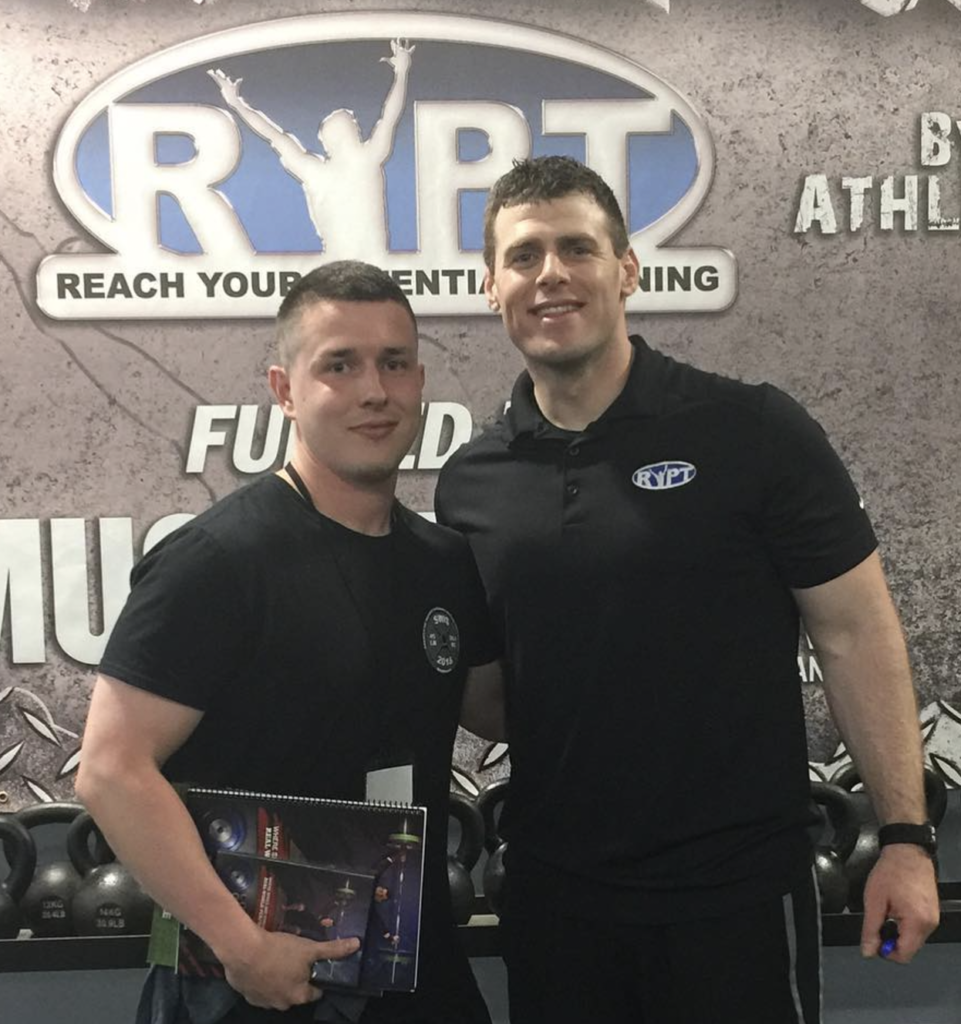
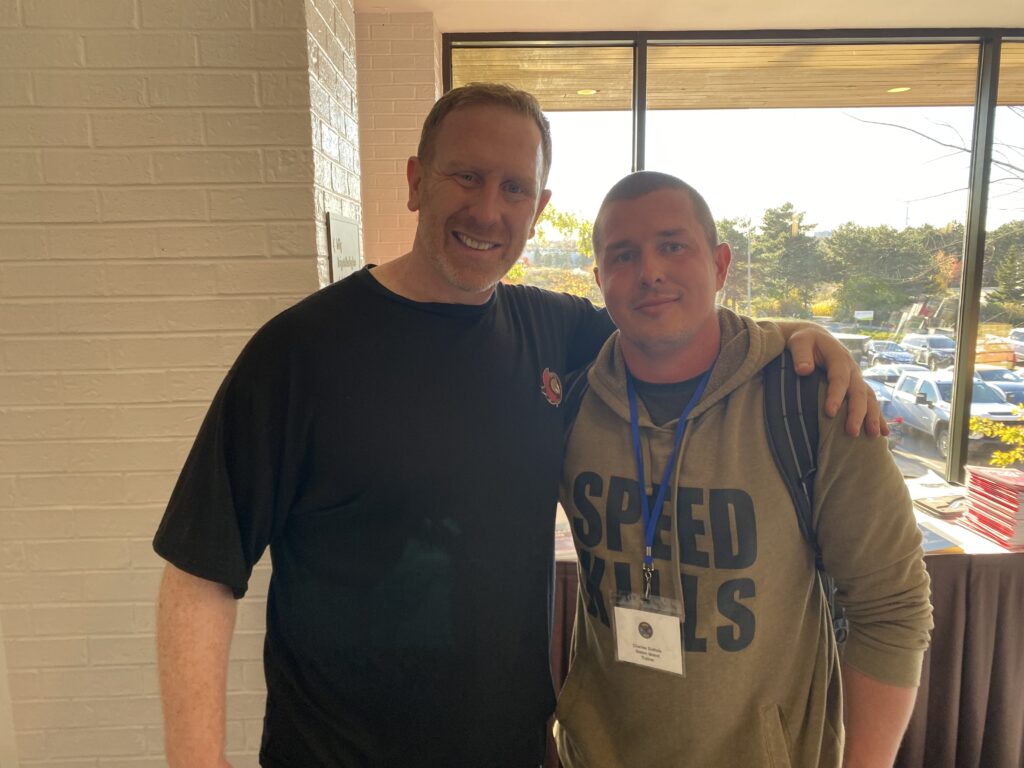
Me with Adam Feit after the 2017 Speed and Power Summit

Over the years, Kav showed me the seminars to attend that led to me meeting Adam Feit, Bobby Smith and Alison Culley through the Speed and Power Summits run by Athlete’s Acceleration. These events were held at Reach Your Potential Training in New Jersey and Adam and Bobby ran a phenomenal facility. Alison has also come through in the clutch numerous times in helping me get me CEUs. After hearing so much about them, I got to finally attend the CVASP seminars in Richmond, Virginia run by Jay DeMayo.

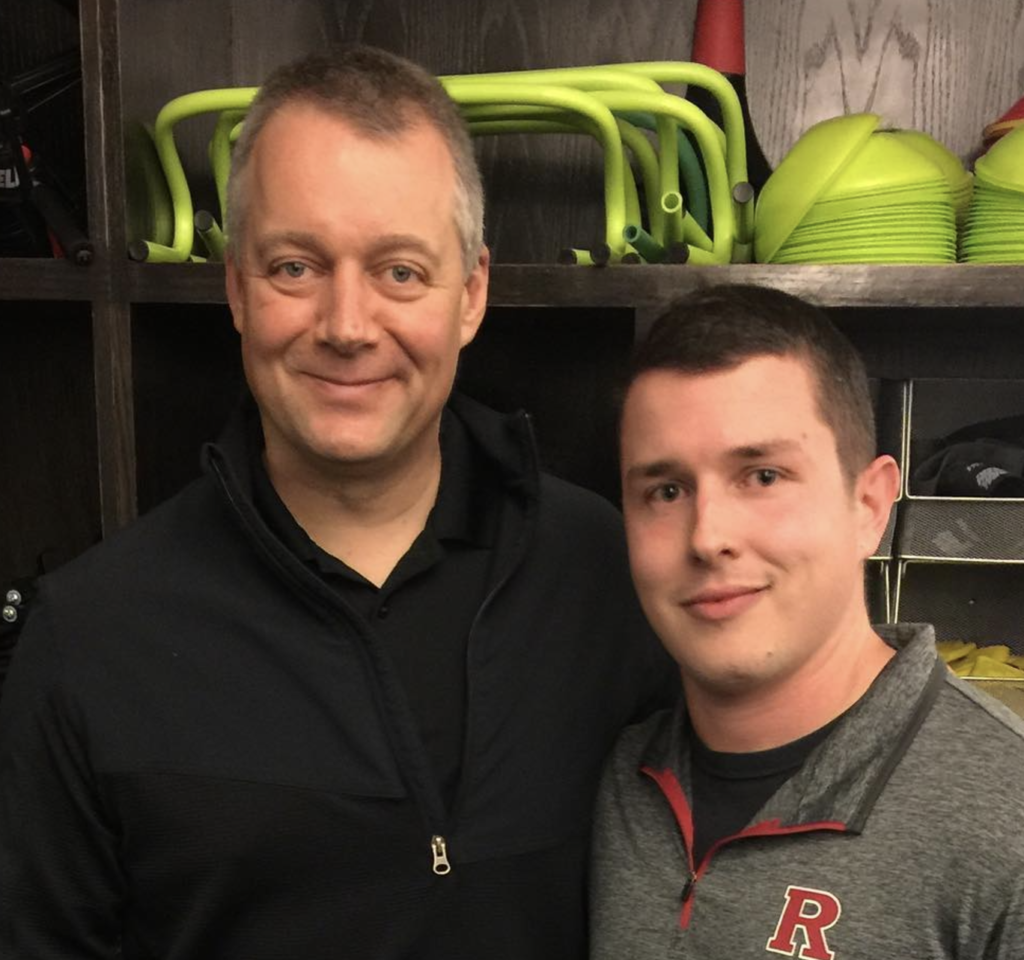
I met former NY Rangers S&C coach Reg Grant at the Pro Coaches Clinic.

Going to all these events gave me a better idea of what to look for in a seminar and where to find some to go on my own. I started listening to more podcasts and that’s what led me to the PLAE Seminar that was held at the Under Armour facility in Baltimore and the Pro Coaches Clinic, which actually took place in New York City. That seminar always stands out to me because it was a short trip to the city in the middle of a school week. I’d also make the trip to a baseball-centric conference in Boston when I attended the Elite Pitching Performance Seminar.

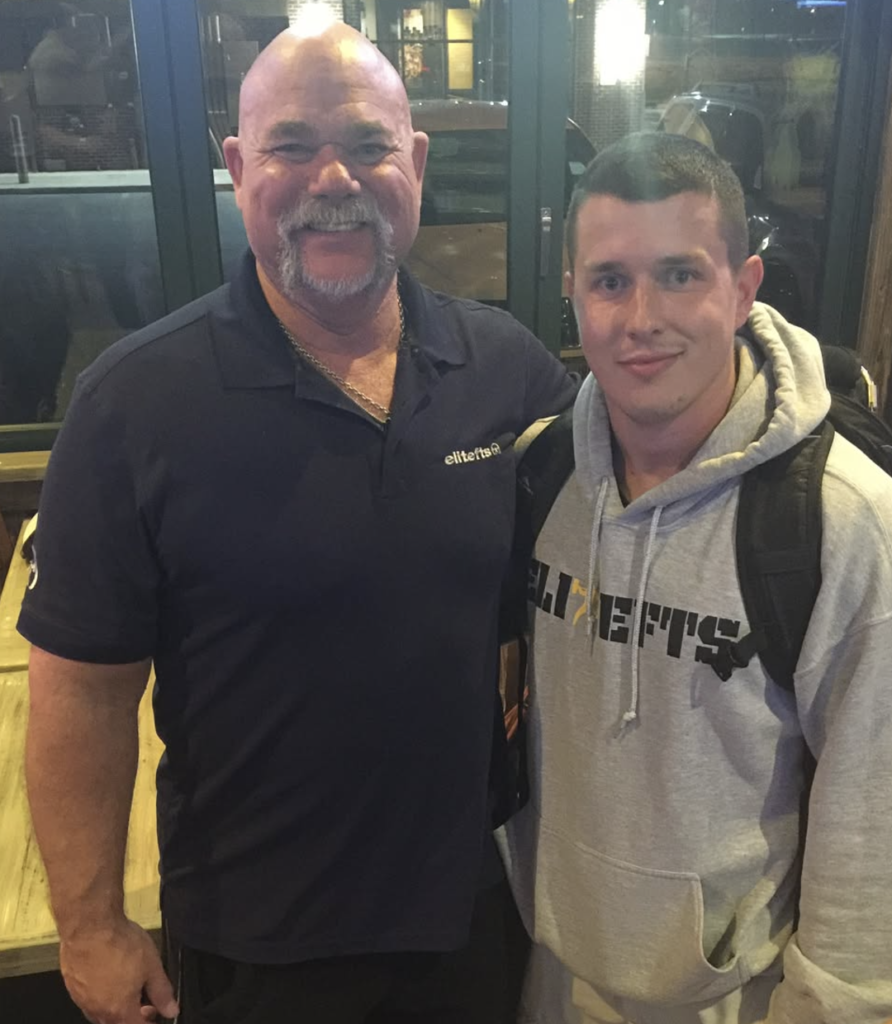
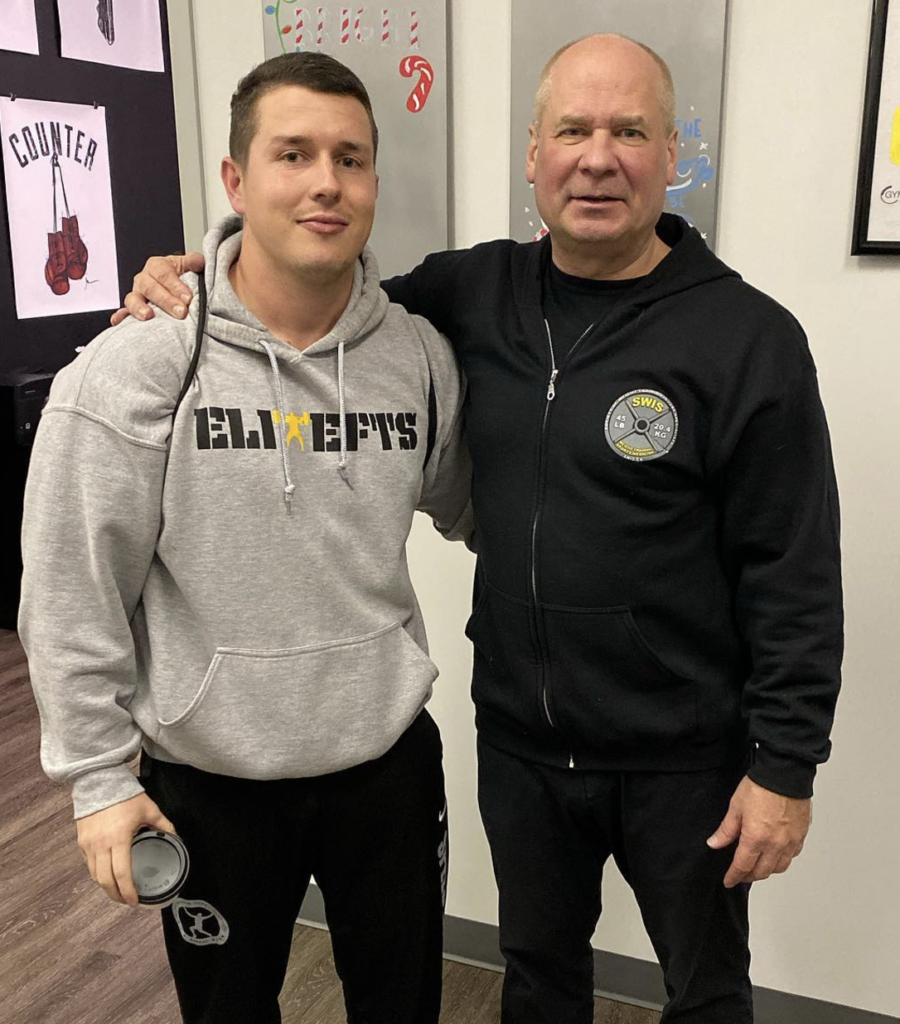
Me with Dave Tate after the elitefts Sports Performance Summit in 2017.

During this stretch, I was also attending SWIS each year and my confidence to go up to the speakers grew as I got more comfortable. One of the big conversations I had was with Dave Tate, the owner of elitefts. He gives everybody his full attention and had a long conversation with me that eventually went into writing. Funny how it keeps coming back to writing. He offered me the chance to write for his website, which gave me the opportunity to write about my time at SWIS and, also, the trips I’d make to Ohio for the elitefts Sports Performance Summit and Business seminars.

During my trips to Ohio, I got to meet Ben Hollander. We talked online because we both went through the DeFranco SB911 challenge. He would have won his year, but he started off in too good of shape and they had to make another category for him. As a fellow Las Vegas aficionado, it was great finally meeting him in person and he would show me where the best spots to eat in the area were. He’s one of those guys I’ve been able to follow throughout the years and it’s been awesome seeing him move up the ranks to becoming a strength coach at Arizona University.

Me with Matt Nichol at SWIS 2024 in Toronto.

As I started to get to know more of the speakers at SWIS, one presentation that was always must-see for me was Matt Nichol’s. Matt’s presentation in 2015 was actually the first one I ever attended. I still go back to it because in-between the Simpson’s references and funny stories about his trip to Westside, Matt talks about seeing the forest through the trees. It was a part of his presentation I’d refer back to frequently because it gives you some guidance when you feel like you’re drowning in new information to the point where you’ll never catch up. At the last SWIS in 2024, he joked with me that this was where we would have our annual meeting.

In addition to all the traveling, Kav held a lot of in-house seminars at SSI where he brought in the best the industry has to offer. Kav took away all of the guess work in trying to figure out who to listen to and just brought the best to his house. These events were all inclusive, too. Not only did I get to listen to these people present, but the intimate environment made it where I got to know them on a personal level and had the opportunity to have dinner with all of them. On the training side, they all gave me something that I still use or remember to this day.

Me and Gary Mahabir with Ian King after he presented in Virginia in 2018.

These events gave me the opportunity to truly meet the main sources of information. Ian King and Henk Kraaijenhof are two coaches who get referenced often in the presentations of others. King, who I’m going to go into more detail in another post, really woke me up with his in-house presentation and changed my view of training. You won’t see many with his approach to training and it led me to taking his Level 0, 1 and 2 KSI courses. Going from one legend to another, I got to see the renowned sprint coach Kraaijenhof show the technology he uses to test hamstring strength on Nick Mayhugh.

Another coach who’s work led to me taking their online courses is Mai-Lin Dovan. I got to see her present and worked with athletes with Lea Thibault. There’s a lot to go through with her courses so I’m still in progress towards finishing them. She was just a great person to talk to and she changed my view on what is considered lean.

Me with Dr. Ken Kinakin after he presented in Virginia in 2019.

Dr. Ken Kinakin, the creator of SWIS, gave a great demonstration on muscle testing, but his best work is what he did to fix my shoulder. I was dealing with anterior shoulder pain for months and he needed approximately five minutes to fix it. Once again, I saw firsthand how the best in the business find solutions fast. Through Kav’s in-house seminars and the times at SWIS, it was always great getting to see Ken. Even when he’s got thousands of things going on and he’s running around everywhere, he always takes the time to welcome you. Jason Dhir is one of the nicest people you will meet and also one of the most knowledgeable when it comes to supplements. His Amino Code by Ultra Human supplement has been one of my go-to’s for years and one of the first things I recommend to people.

I’ve gotten to watch Julia Ladewski and Mark Rogers, two experienced coaches and power lifters, give a hands-on demonstration of the big three lifts and their checkpoints are what I use to this day, especially with the bench press and deadlift. Jeff Moyer, who is one of the best when it comes to vision training, gave me tips for improving batter’s eye that I’ve used on myself and others. Nicole Rodriguez went into the systems she used at EXOS and gave me a way to progress and regress plyometric exercises that became pivotal when I started building my youth client base.

Now, on the advice side, that’s where I turn to the presentations given by Joel Proskewitz and Heather Pearson. Joel, one of the leading spinal experts, talked about how the things he was teaching aren’t meant to be used right away and that it takes time to learn them. It was a tiny part of his day-long presentation, but it stood out because most people talk about takeaways you could implement right away. He really went in-depth and, I’ll be honest, a good portion of it was over my head. That line always stuck with me. Another one came from Heather. Heather is known as a “magician” in the rehab world, but she talked about visualization at the end of her presentation. She said when athletes are visualizing success, they need to do it from their own eyes and a first-person perspective, not from the outside. That struck me because so many times when I would visualize myself succeeding, it would be like I was watching myself from the outside. I still use her technique to this day. Kav also brought in Brett Bartholomew right as his Conscious Coaching book was taking off. I learned that movies aren’t the only things made with alternate endings.

One of the biggest lessons I’ve learned in life as I’ve gotten older is that not everybody wants you to win. It’s a harsh reality, but one you need to learn. The secret is to find those few people who truly want you to succeed and do whatever you can not to lose them. That’s what impressed me about Kav’s Coaches Room Mastermind where I’ve been able to connect with great coaches from all across the country. I picture a few of them reading this and laughing, but I do leave every event with a better mindset.

Me with CJ, Kav and Gary after a Mastermind event at CJs gym in 2021.

One of the guys I reconnected with in the group is the Beard Boss CJ Appenzeller. CJ is just an awesome dude who will take you in and help you out however he can. I first saw CJ present at the CPPS in 2016 and met up with him at the elitefts seminars and Pro Coaches Clinic in 2018 before the mastermind. He’s been so helpful to me. Two areas where I know he’ll give me the best of the best are when I have a baseball training question or when I need an impression of a coach. He’s impressions are top notch. Then there’s, Gary Mahabir, a fellow NY native, who is not only one of the nicest people you’ll meet, but has a physique that people half his age would kill for. Driving back from one of the masterminds with him was one of the quickest four-hour drives I’ve ever had. There’s a lot of things you can say about Gary, but, to put it simply, it’s great having somebody like him in your corner.

I’ve got a lot of fond memories of the coaches I’ve met from the mastermind. It features people from all over, but New York is well-represented with Nick Tintle and Eric Chessen. Nick was in California when I met him and is now running a lacrosse business in Texas, but he was a standout lacrosse player in Long Island and he gave me the chance to break out my limited tri-state lacrosse knowledge from when I was in newspapers. Eric, also no longer a New Yorker, runs Autism Fitness and his dry sense of humor is top notch. He’ll make a joke out of nowhere and at the most random times that will crack me up. Then there’s Dave Brix, who puts David Goggins to shame. This guy truly lives what he says. The capper for me when I was coming back from a night out in Vegas and he was just getting done with his workout. On the west coast there was Javier Miller-Estrada and Jason Maher. Javy is another solid person and it’s been great seeing what he and Rob Gambardella have done out in Arizona with Ignite Performance. Jason is an awesome guy to talk sports with, even though he’s a Boston Red Sox fan. I’m sure I’m missing people because the mastermind has grown, but Kav filled it with quality people and it let me know I was in the right room and on the right path.

Kav took the mastermind group to the UFC Performance Institute in Las Vegas in 2018.

These masterminds covered everything and Kav would bring in people from all walks of life to help your business. Two of my favorites to learn from came on his social media/video creation side with Ryan Magin and Chris Perrilli. I also learned Ryan is a great guy to have with you when one of the events is held in Las Vegas. On that trip, we got to check out the UFC Performance Institute and then Ryan took over for the nighttime festivities.

So much went on during this four-year stretch. Writing about it was hard because I’m trying to pack in so much information and do it as concisely as possible. Any of the events or people I mentioned I could write a whole post about. I put off writing about it for a while because I just didn’t know how to go about it. I just decided to write down the key events on a piece of paper and go off about them.

This post also gave me a chance to look back on some fond memories. Going through the 10 years reminded me of where I started and then this post reminded me of how much opportunity and growth took place. This stretch made me who I am today. In my first two years, I’d have people coming up to me trying to tell me what I was doing was wrong and I’d actually give them the time of day. Now, there’s not a chance of that happening. I wouldn’t have that confidence without the experiences and people I’ve met over this time.

When I was starting out in 2014, I couldn’t ever imagine having these experiences. I figured that I would start going to conferences, but I couldn’t picture it happening anywhere close to this level. And none of this would have been possible without Kav reaching out to me with that phone call on January 2016. He told me never to write a post about what he did, but I can’t tell my story without mentioning it.

Officially 10 Years Training – 2015 – High School Training Starts, SB911 and SWIS

Now that I had a couple of clients on my roster, the next step was to figure out how to break into the athletic training space. I was drawn to training youth and high school athletes because of my background, but I had no leads in sight. Plus, it didn’t help that I was being told that it wouldn’t be sustainable or even possible for me. It hurt to hear that, but it didn’t really deter me because I wanted to be around sports.

I know I work with mostly youth athletes now, but the idea of youth training didn’t cross my mind at the time. I was working in a gym where the youngest people there were in high school. Instagram and social media wasn’t what it is now, so I didn’t really know of anybody that was doing youth training.

I finally got my break in 2015, but it came with a caveat. I hated selling, but you better believe I put on my best salesman work when Joe Desilvio and Luke Santore came in. I sold to them like my life depended on it and I was able to land them both. Unfortunately, they told me ahead of time they wanted to do one contract’s worth of training. Joe had baseball coming up and his summer was swamped and Luke just wanted to get started so then he could go off and train on his own. They were upfront about it and they gave me a chance, all I could ask for.

Not what I wanted to hear, but beggars can’t be choosers and I was determined to give them the best experience they could get. Joe was a baseball player at Monsignor Farrell High School, where I played growing up, so he was everything I was looking for. I was excited landing him as a client because I always wanted to work with high school baseball players and I got the opportunity to break out some of the baseball and athletic training exercises and drills I’ve been reading about. I didn’t have him for long, but the good news was he wound up making the varsity team and then, two years later, continued playing baseball at John Jay College.

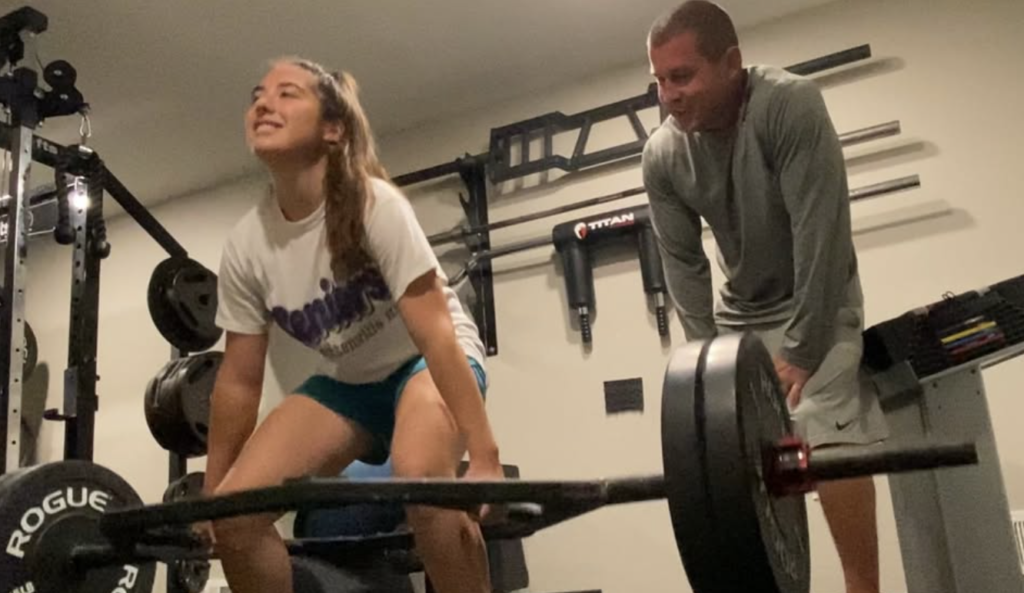
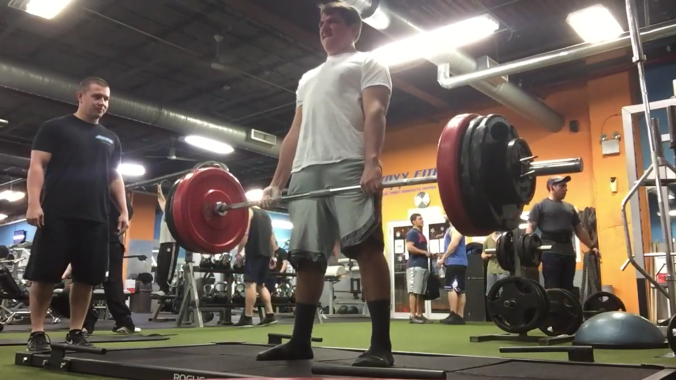
Luke deadlifting 345 pounds on his final session with me.

Joe I had a couple of months, but the 15-year-old Luke and his dad gave me a year. Luke wasn’t on any teams, but definitely could have been a football player if he chose that route. I thought we were going to have to take things slow, but he was a gym rat by day one. Over time, I gave him stuff to do on his own and I’d see him every week getting after it. The year was awesome and his lifts went through the roof. On his last session, he deadlifted 345 pounds and was close to bench pressing 225 pounds. I knew he would be good on his own, but man it was hard letting him go knowing what could have been if I had another year. I still see him at the gym and he’s a monster.

So far, things were looking pretty good. But, the trajectory shifted and it had me questioning myself. Luke and Joe were awesome, but they were soon gone. Camille was doing amazing work, but she was moving. Jess was flipping tires, box squatting and pushing sleds, but she moved, too. I was losing people. And, while it was for circumstances out of my control, it hurt. These were people that helped me grow up in this business and losing them never crossed my mind (except for the boys, I knew I only had them for one contract). I’d pick up people here and there, but they’d either do the three-session trial or sign up for a month and then be gone.

The doubts start creeping in again. How am I going to sell myself to more people? I thought I was starting to get passed that. Then, I’m looking at myself in the mirror and wondering if I’d ever actually get myself in any real shape. How could I be a trainer if I can’t even get myself in better shape? The doubts were coming out of the woodworks.

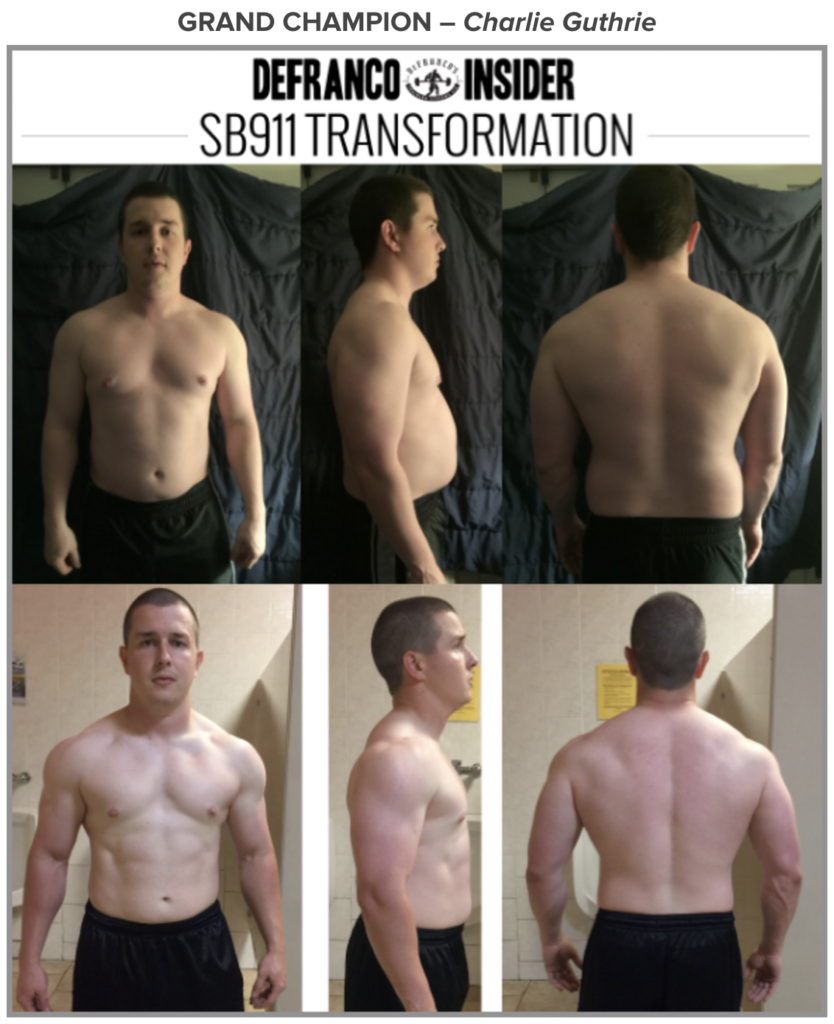
For the past couple of years, I’d been following Joe DeFranco and running his training programs for myself. He came out with a podcast in 2014 and made an announcement in March that he was coming out with a new program. His “Westside for Skinny Bastards” program was his main online program that he was known for and he was coming out with the upgraded version called SB911. If you were a part of his Insider group, which I was, you’d get to test out the program and be a part of a transformation contest.

I’ve never really made a transformation in my own training before, but was willing to go out given the stakes. I didn’t care about winning, I just cared about placing in the top 3 because that would give you a one-hour consultation with Joe D. and Jim “Smitty” Smith. I felt like it was perfect timing because I needed a kick in my training and would be going to Las Vegas for the first time over the summer, where I’d have to take my shirt off to go into the pools.

I figured it was put up or shut up time. If I’m really as upset as I claim to be and want to do all these things as a coach, well here’s my chance to take a stand. I’ve written and talked about it so much, so I’ll just save you some time and tell you I won. I talked about winning the contest on my site here.

Making that much progress, getting compliments from people and finding out I won gave me a huge boost in confidence. I thought maybe I actually can do something now that I’ve shown that I could actually get myself in shape. This contest opened up the door to me traveling to seminars.

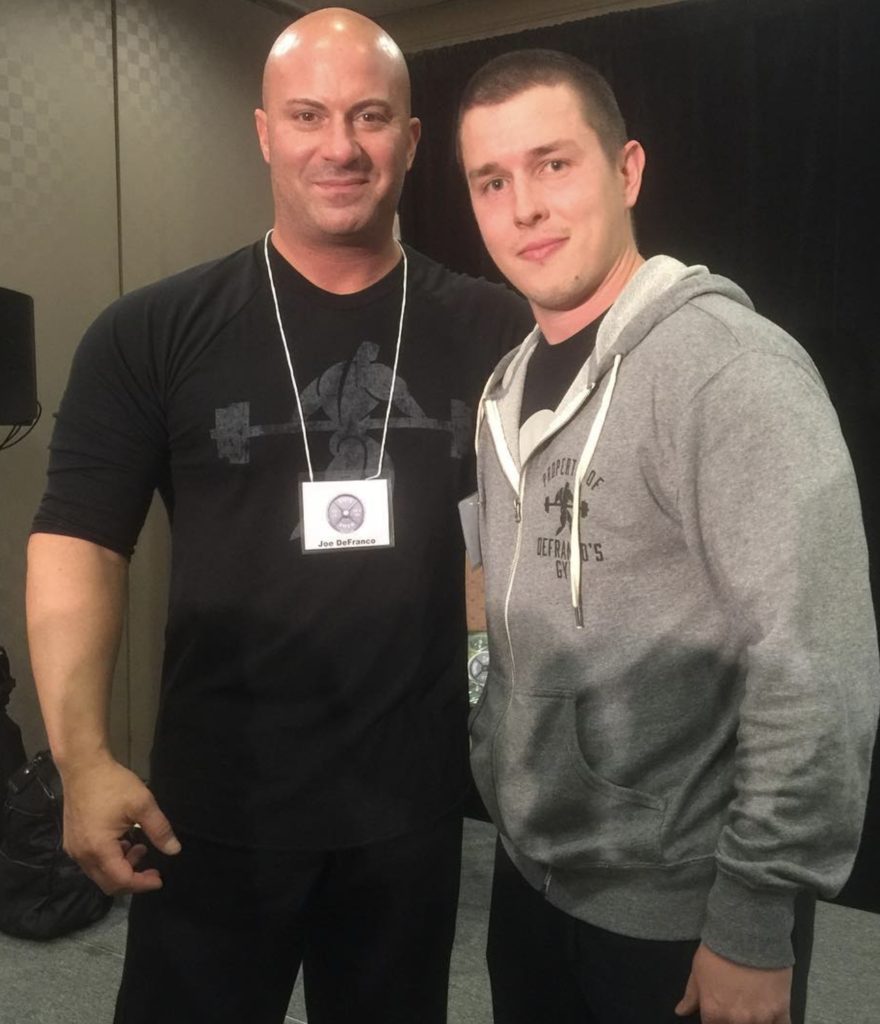
Me with Joe DeFranco after his presentation at SWIS 2015.

I’ve heard so many coaches that I followed online talk about what they’ve learned from going to seminars across the country and interacting with different coaches. For the longest time, I had no idea where to even look for these events. I developed a small online friendship with Joe D. through the contest, so I finally got the courage in late August during one of his Q & A’s to ask him if he would be presenting anywhere.

That’s when he brought up the SWIS Symposium. He said it was up in Toronto in November and it was one of the best seminars that was out there. If you were going to go to any seminars, this would be the one to go to. He said the things you’ll learn there will blow you away. After going to SWIS every year since, I can tell you it’s the best run seminar there is. I’ve never flown anywhere solo before. It was costly and I wasn’t making much money, so I did have a conversation with my mom about whether or not it was worth it. I was leaning towards doing it and she pushed me towards booking it. She became a fan of Joe which helped.

Me with Dr. Tom after his presentation at SWIS 2015.

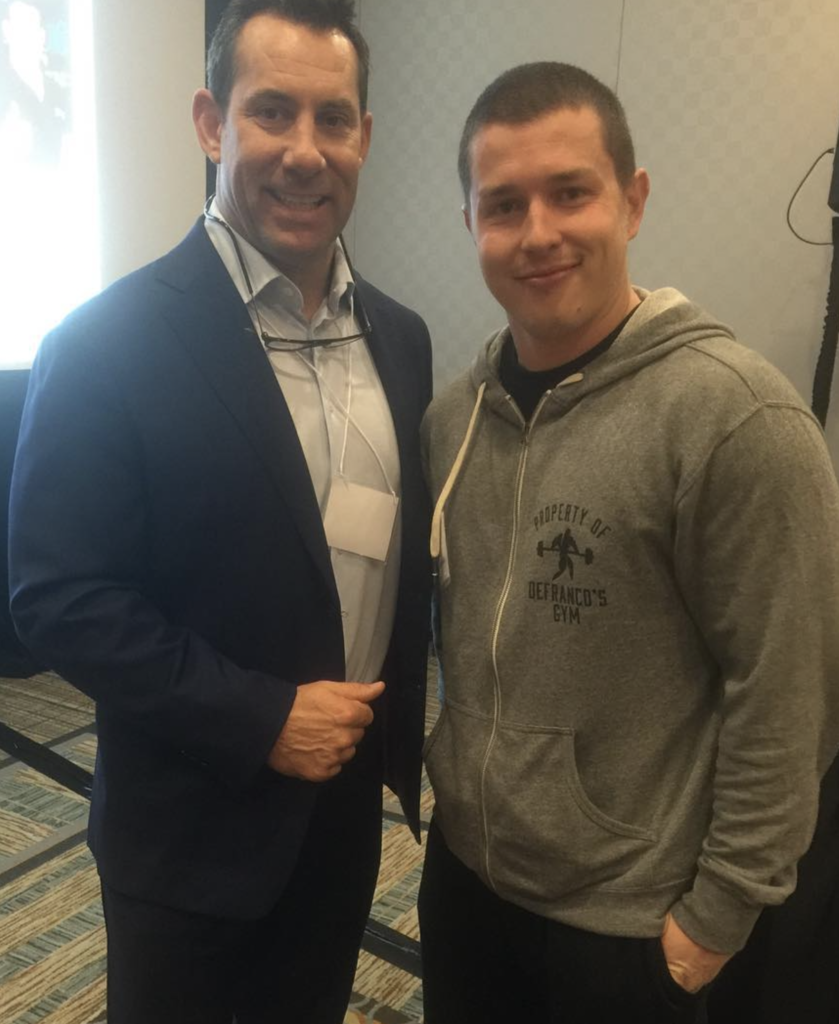
At the time, I had no idea that I was going to be making a trip that would change the entire course of my training career. And I wouldn’t have any idea of that for a few months after the fact. The trip to Toronto started off with a bang because I met up with Dr. Tom Bilella, who most know as Dr. Tom. Dr. Tom came up to me when we landed because he saw I was wearing a DeFranco hoodie and introduced himself and offered to pay for a cab to the hotel. Dr. Tom was speaking at SWIS and worked closely with Joe D. for a lot of years. Here I was, a nobody in a sea of some of the best coaches in the world, and Dr. Tom made sure I was comfortable. He was an awesome man and actually worked with my mom, my aunt and me on nutrition and taught us a whole lot.

SWIS was part inspirational and part disheartening. Seeing all of these high-end presentations opened my eyes to what is truly out there in the training world. I saw there are so many things out there that the average person couldn’t comprehend. It made me want to get to that level. While that was good, it was also quite humbling. It showed me how little I know. I didn’t really know where to go for certain time slots, I was mostly there for Joe D’s presentation, and wound up sitting in presentations where I had no clue what was being said. The stuff was going right over my head and it had me wondering if I’d ever be able to learn and apply even a fraction of the things being discussed. This was a conference was so high level that you could be in a presentation where the attendees are more distinguished than some of the presenters.

I’m just sitting there listening to stories about these guys training and treating all sorts of pro athletes, Olympians and teams and their state-of-the-art facilities and equipment. These guys have all these stories and I’m making $10-to-$15 an hour training out of a commercial gym. I was the small fish in a very large pond. I did take some pictures and talk to some people, but the imposter syndrome was kicking in. I did not feel like I belonged.

On the last day, I ran into Justin Kavanaugh and Dylan Seeley. Both of them could see that I was the odd man out, but came up and talked to me. Justin bet Dylan that I wouldn’t email him and connect with him. I’m a terrible salesperson and not good at being social in crowds where I don’t know anybody, but I am good at getting back to people after connecting. That was one thing I learned from working in sports media.

The first thing I did when I got home was send Justin an email. I didn’t know much about him and I didn’t know if he would ever get back to me. He never responded to my email, which anyone who knows Justin will laugh about, but he did friend me on Facebook in December.

I had no idea if anything would come of that email. I just went about my days wondering where I would go as a coach. I would find out the implications of that email the next year.

Officially 10 Years Training – 2014 – Trying to Figure Things Out

I’ve been asked by a couple of people over the years about getting into personal training. Each time, I look back to my first year doing it and tell them two things: don’t make it your full-time job right off the bat and you better love the process of training people. I don’t say that because I hate what I do. I say it because you start at literal zero and it takes quite a while before you make it out of the basement.

Social media clouds people’s judgement. You get the full spectrum of BS on there. You’ve got the mixture of young kids just out of college and mediocre powerlifters telling you to “DM them for online training” even though all their posts are just them lifting and they’ve never trained a soul. Then, there’s the social media coaches that even other coaches follow who claim to have trained thousands of pro athletes, but there’s not a single post of them with an athlete. On the other end, you can’t forget the “coach of the coaches” that claim you’ll make $10K per month with them even though they have no real success stories. There’s so much garbage out there and you don’t learn that it’s garbage unless you’re in the business long enough and around the right people.

People see all of this online and think it’s easy. I’ve even been asked by people, who had good intentions, why don’t I try to be like so-and-so. I have to explain that the person isn’t a real coach and most of their followers are fake. If posting shirtless selfies and videos of me working out were all it took to be successful, I’d do it. Trust me.

If you’re patient, in it for the right reasons and have plans on growing as a coach, you’ll make it for whatever your long-term goal is. For me, my goal was to always make this a successful job after school where I worked with athletes of all ages. I wanted to be able to help people and have the stories to back it up. I don’t like having to sell to people, so a referral-based business works much better for me.

What worked in my favor in the beginning was that I am patient. I’m also pretty optimistic. I always believed that you need at least one goal that people think is crazy. I get down on myself plenty of times, but I always believe that if you’re in the game you have a chance. It’s not something that’s going to happen right away, but if you stay in it and keep working towards your goal, you’ll be rewarded eventually. Patience and optimism was necessary because the clients weren’t rolling in for me in the beginning.

My first client wasn’t a paying client. It was my brother, James. He’s always been my biggest supporter and would do whatever was needed to help me out. He did enjoy training and willingly volunteered to do whatever I asked during my sessions to get better. If I saw something online that a pro athlete was doing, you better believe I had him trying it out for me. He was willing to do whatever was needed to succeed and I don’t know where I would be without him.

A moment I look back on was a few years ago, before I started training, when he first walked into a gym with me. I didn’t know any better, so I was going to have him just join in with a program I was doing. Some things were hard for him and I didn’t know how to coach him besides saying just do it like I was. Fast forward to 2014, to be able to actually show him the right way to do certain exercises was a nice boost for me. I could actually give him the cues to perform an exercise better instead of just saying “do it like this.”

(As a sidebar, those moments with my brother before I started coaching come to mind whenever someone tells me they just need one session and then they’ll show their kids the rest. I will oblige and show them, but then I think to myself: you don’t workout or know anything about training and progressions, but you’re going to train your kid now? Do you go to a tutor and say just show my kid how to do three problems and I’ll take care of the rest? This is where people think they can just grab stuff off of Instagram and that just leads to more problems.)

Eventually, I was able to land my first paying client, Theresa Folino, on my first sales pitch, but she was the only person that I could convert for a while. I hated the selling process, mostly because I was terrible at it. I closed like Aroldis Chapman in an elimination game. For the first month I didn’t think much about it. But, then, after a couple of months of not landing anybody, I did start to question if I could actually do this.

On top of not being able to sell, the other issue is I really didn’t know what I was doing outside of what I learned in the textbook. Theresa was perfect for me because she was coming off an injury and wanted to slowly get back into training. I’m glad that was the case because I couldn’t offer her much more outside of the basics anyway. She was a trooper and made my life easy as I tried to figure things out.

The only other client I picked up during this time was a lady named Leigh DeFazio, who was given to me by Kim Kehoe. Leigh’s schedule changed and Kim was unable to train her because she worked at a school. Leigh was willing to do whatever I programmed for her and she gave me the opportunity to go outside the box as I was learning more. This helped me gain a little confidence as I was trying to get clients and would be one of many nice things Kim has done for me. Kim is another one who has always been good to me and my family and somebody I trusted to train my mom. You know Kim is good when my mom followed everything she said.

Fortunately, when I was able to finally connect and land some people, they were gems in Jennifer Imperatrice, Jene Romeo, Jess Livan and Camille Faccio. Picking up these ladies was huge for me because there was really a point in time when I didn’t know if I would ever get another client. Things were looking bleak for me. What made it even better is that they were awesome people. There’s nothing worse than getting a client that makes the time drag. All of these ladies were a pleasure to train.

Jennifer, like Theresa, wanted to get back into the gym and she loved the weights. She didn’t care if it was a machine, a free weight or the trap bar, she wanted to try it all. Jen would ask me questions about the different pieces of equipment and wanted to try everything, in a good way. She loved wrestling, too, so we would keep each other up to speed on what was happening because she knew I loved going to events with my brother. She would come around 7 or 7:30 p.m. after work and was always in a good mood and a bright spot.

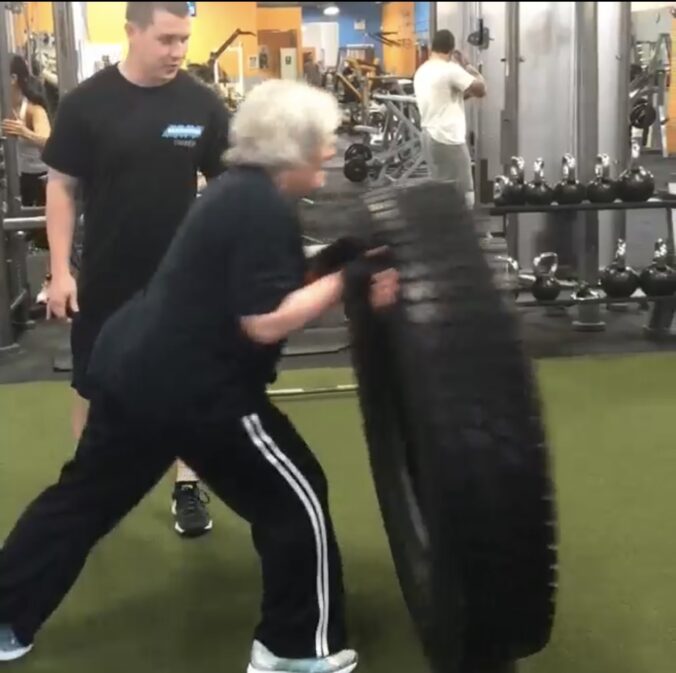
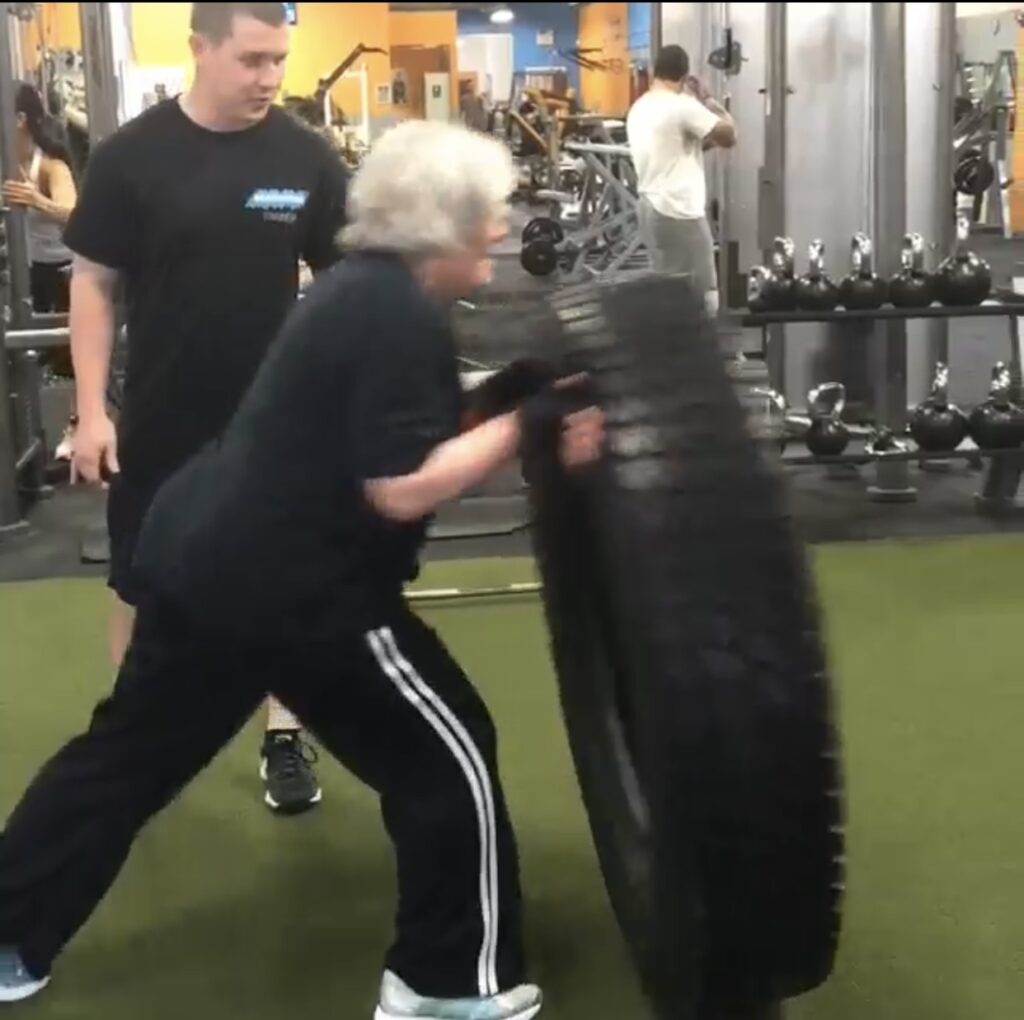
Jene flipping the tire for the first time.

Jene was in her 70s and used to be an archeologist. Her goal was to build the strength to be able to go on one more dig. We started off slow, but as she gradually got better, she wanted to increase things and started trap bar deadlifting and even flipped some tires. She came into the gym wanting to keep things basic, but, as she got stronger, she would stare at that tire and tell me that she wanted to be able to flip it. In addition to being a hard worker, she was the social butterfly at the gym who made friends with everybody and lit up any room she was in with her personality. Within two months, she had more friends at the gym then I did.

Jess came in and challenged me a different way. She had either a dancing or gymnast background (I always get the two mixed up) and I had to up my game. She was an athlete and she can move, so I had to go into the bag to come up with different ways to challenge her. It was a fun process for me because she challenged me as a coach. People don’t realize this now because things have changed, but there wasn’t many women at our gym at this time. She made me feel pretty cool because here I had this woman pushing sleds, working with a barbell and doing things you weren’t accustomed to seeing a woman do frequently. In between, we would share school stories and those were always entertaining.

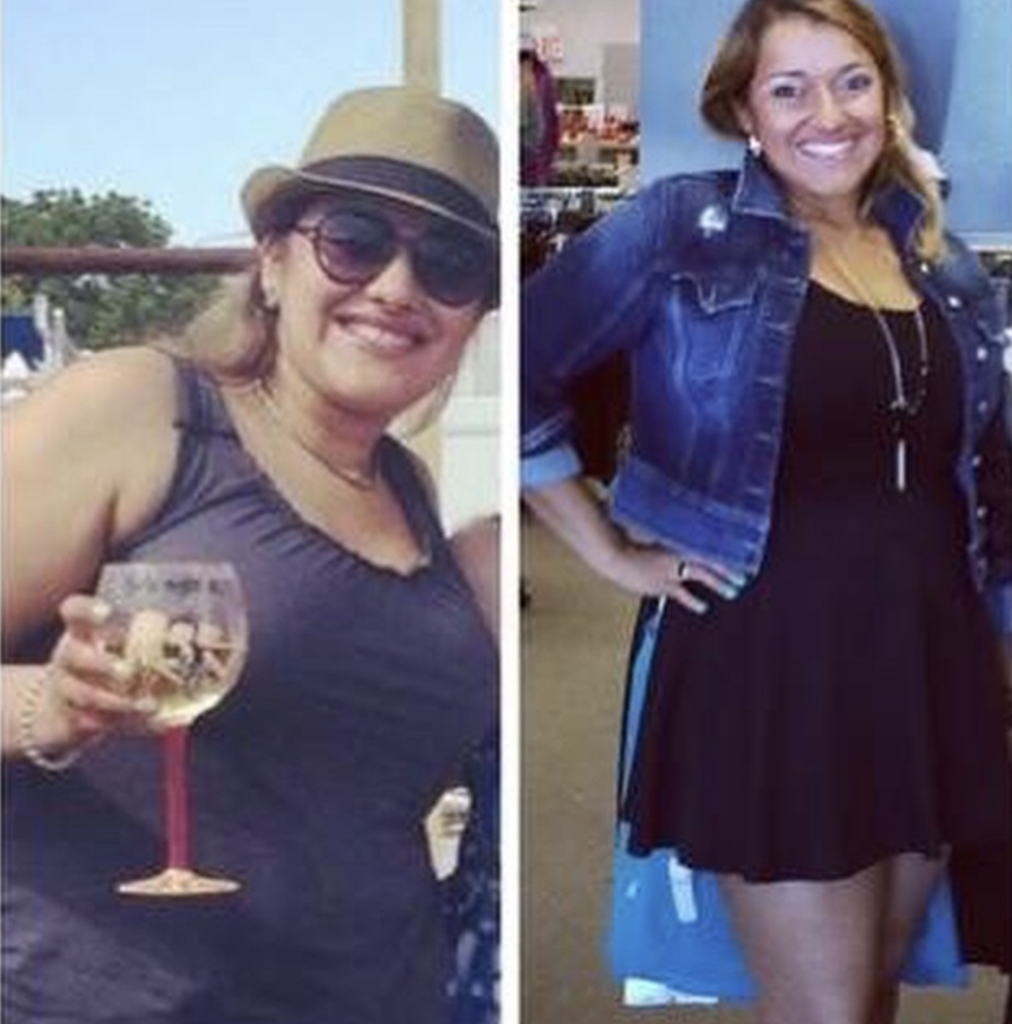
Camille lost 49 pounds in six months.

Camille will always be special to me because she wrote the first testimonial for me. She came in focused and worked out like a savage. She went to a nutritionist, trained with me three times per week and then worked out on her own. She is somebody that I would say made every single minute of a session count. She wound up losing 49 pounds in six months and she gave me a huge spark. Before I started working with her, I kept wondering if I would ever be good enough to actually help anybody. My clients were making progress, but I didn’t have that before-and-after picture to show that I was really making a difference. Everything was just based off of what clients told me. I’d see these before-and-after pictures online with these drastic changes and didn’t think I’d ever actually be able to get one of my own. Camille showed me that I had some hope. It certainly didn’t hurt having a woman like Camille who was not letting anything get in the way of her goal.

I did get some push-back because I do live on Staten Island where if people have the opportunity to take you down a peg they will. I’d get comments from other members about my training and someone even asked if anyone makes any progress doing training or do I just take their money. Now, I understand I was a new trainer and didn’t have the most experience, but it wasn’t like I was putting my clients through these wild exercises. Somebody told me squatting to a box was not a good exercise.

Those comments were relatively small in the grand scheme of things, but I have a tendency to hold grudges and not forget things. They stung at the time because my confidence was already pretty low and it just gave me another reason to question myself.

One person I have to shout out for being in my corner from the beginning was Gary Miller. I met Gary right after I finished my NASM certification and he let me join him for some of his workouts at the gym. Gary had a lot of experience coaching athletes and people of all ages and has been somebody that’s always had my back. Most people know me now as a pretty good deadlifter, but it used to be an exercise I stayed away from. Gary worked with me on my deadlift and got me to 405 pounds by November. I would not be the deadlifter I am without his early afternoon sessions with me. I always appreciated his support early on.

But, even though I wasn’t loaded with clients, I did have a nice roster of people who made the job fun for me. There was a lot of work to be done, but at least my client roster was greater than one.

Officially 10 Years Training – How did I get Here?

In August of 2013, I was driving up to my dad’s house in Pennsylvania and it was a ride that took my life in a different direction. I get a lot of thinking done on long car rides and, on this one, I was contemplating what to do with my life. I was soaking in the last bits of summer before another high school football season was to begin, and I didn’t know how much more I had left in me. I wasn’t enjoying it like I used to.

At the time, the newspaper business was a six-to-seven day a week grind. That usually wasn’t a problem for me, but the business was changing. A big part of what made the grind fun was all of the friends I made along the way and they were gone. They either moved on to another field or company or were let go. The new people that came in were cool, but the total number of people in the building was much smaller than when I started.

I was 27 and quickly went from one of the youngest guys in the office to one of the most tenured. It was a reality check. The hours will increase, but the pay won’t. In newspapers, you’re just a number. What people don’t understand is whether you work hard or not, if you’re next on the list to go, you’re gone. You can’t outwork your way from being laid off because they just want to find someone cheaper. I was even looking outside of my paper and seeing huge names in the industry losing their jobs.

Reality was settling in and the thought that kept running through my head during this car ride was what was going to do with the rest of my life. I needed to figure out something before it was too late. It was a hard decision, but, after seeing what was going on around me, I was able to come to terms with it. When I was growing up, there were only two jobs I ever considered: working in sports media and being a special education teacher. Now that I realized sports writing could come crashing down at any moment, I needed to pivot. I had to figure out a way to get into the school system and fortunately I was able to.

Then, after I crossed that bridge, the thought of getting into training came into my mind. Around 2010, when the internet started getting bigger, I needed to make a change in my life and started looking up sites about training. Specifically, I focused on training for sports and how to get leaner. I was looking around trying to find the best coaches online. These things weren’t easily accessible when I was growing up, so I thought I stumbled on a gold mine every time I found an interesting article or program. I learned about fasting and thought I found the ultimate diet cheat code. I’d try to share this information with people, but nobody cared.

I figured that since I liked reading and learning about training so much, I should try to pursue it. I had no idea how to get into becoming a trainer and didn’t even know it was possible. It’s crazy looking back at it now, but I thought there was this huge barrier to entry. By the end of my car ride, I decided I was going to dive deeper into it.

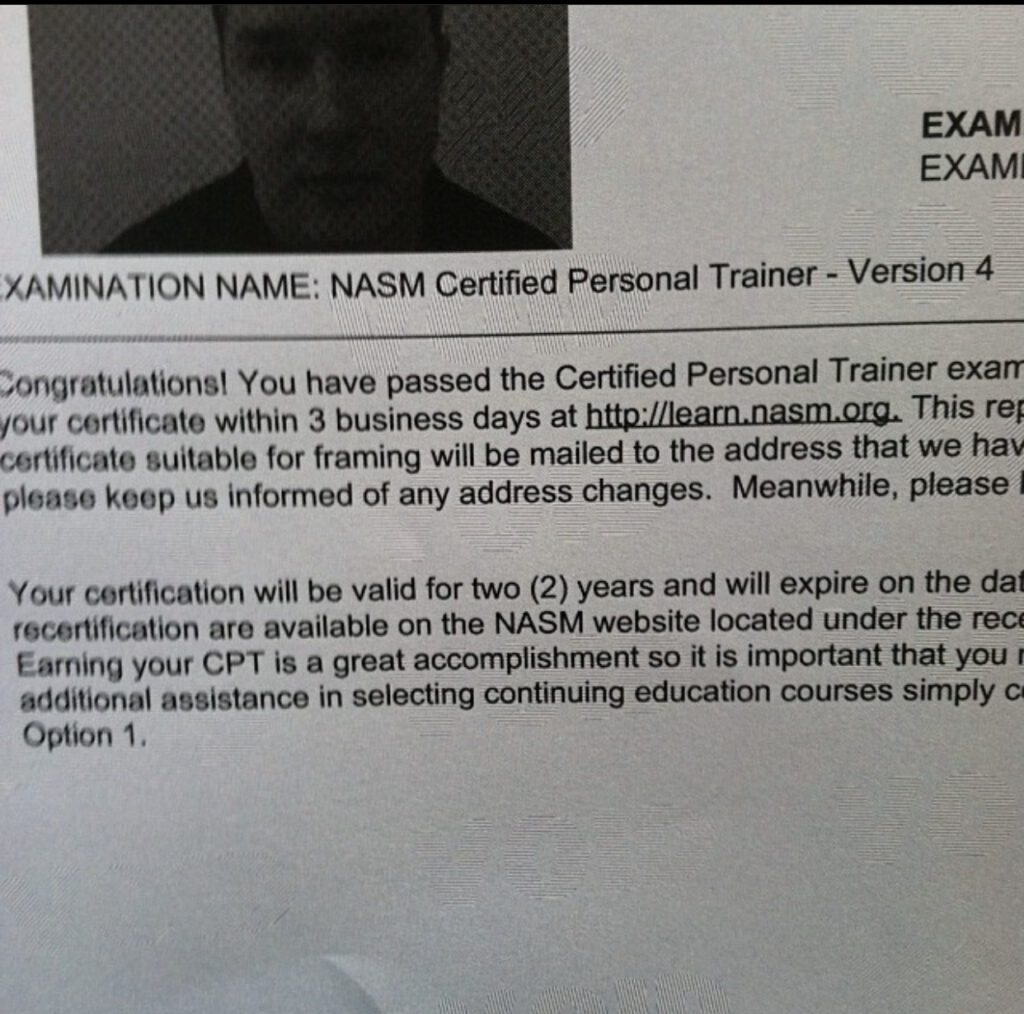
I passed my NASM CPT exam on February 7, 2014.

The next week, I went into my gym and decided to ask John Errichello if it was possible. John ran the training business at the gym, and I’ve known John since I was in high school. John was the first person I met when I walked into Dolphin Fitness, which is now Intoxx Fitness, in 2002. My mom wanted to find a trainer to help me get stronger for baseball and he set me up with Frank Tripodi.

I look back at my time with Frank and it’s one of the things that led to me wanting to work with youth and high school athletes. He didn’t give me this crazy program, but emphasized the basics that still apply today. We did full body workouts to hit everything, focused on getting strong legs and told me how cardio could play a role in helping my strength training. He was also a big advocate for stretching and always said, “Charl, make sure you stretch so you aren’t walking around all stiff like these guys.” Just by doing the basics that Frank stressed to me I noticed an improvement in how I played.

Now, back to bringing up training to John. I think I’ve seen John mad once in my life, but I was still nervous to ask him about training because I didn’t want to come off as disrespectful. I wasn’t in the best of shape at the time and really didn’t know much about training outside of the things I read online. John is just a genuinely nice person and has always been good to my family so I knew he wouldn’t steer me wrong.

While most people would try to shut you down, John was helpful and told me I could become a trainer and that I’d actually be good at it. John said he would help me get in, I just needed to get certified. He said a good certification to start off with would be through the National Academy of Sports Medicine (NASM). He would help me with the studying along the way and, at the gym, took time to go over and answer any questions I had about training people.

I wound up studying the textbook every night when I got home from work. I’d get home around 1-to-2 a.m. and would read for about an hour or two each night. Outside of weekends, I didn’t have to get up early, so it wasn’t a problem. I was used to going to bed when the sun came out anyway.

The work paid off and I passed my training exam. On February 7, 2014, I was officially a certified trainer. I had no idea what the future would hold.

Recapping the Summer Sprint

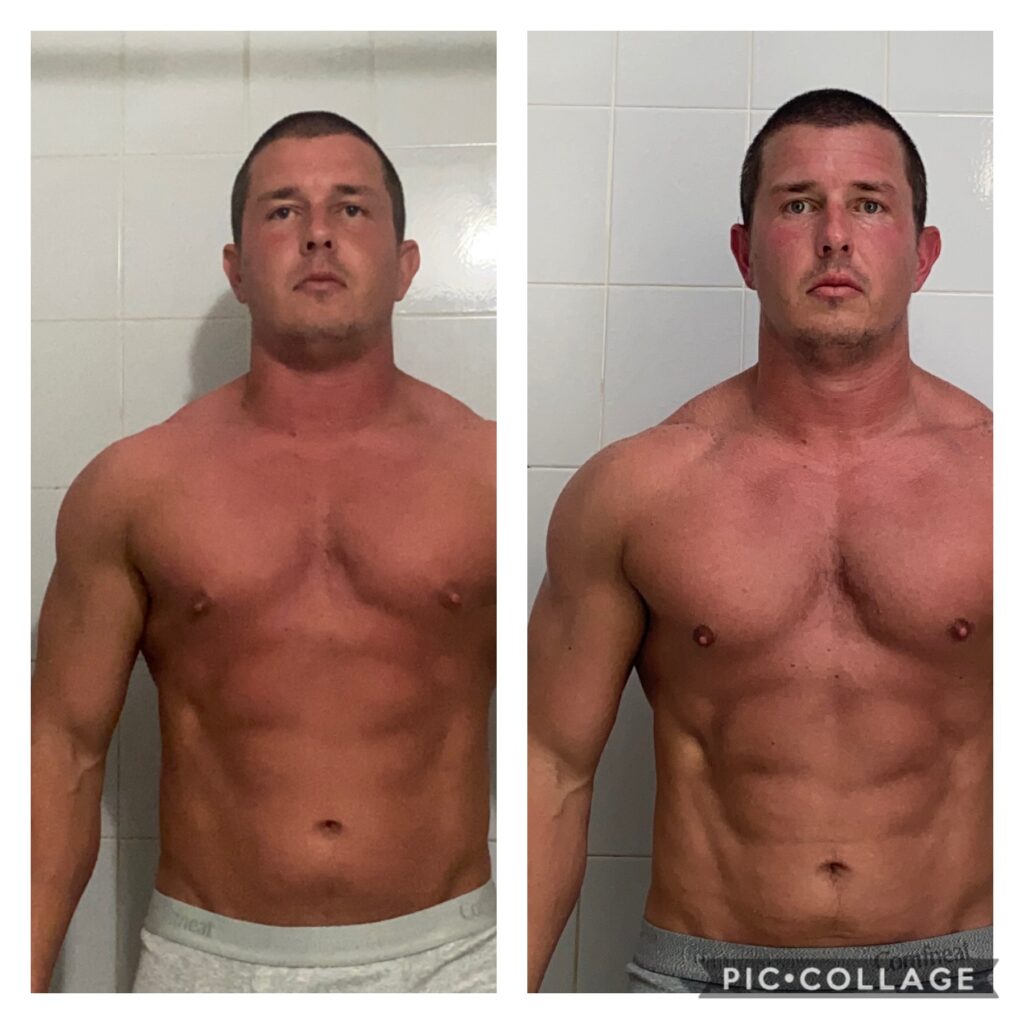
On the left, I was 194 pounds on July 10. On the right, I was 185.6 pounds on August 4.

If I was ever to put together one of those training montage videos, it would almost exclusively come from what I do over the summer.

My best training of the year always takes place over the summer. School is out, the weather is amazing and my schedule opens up a bit, which allows me to train with the frequency I want to. I also have all of the important factors outside of training (sleep, stress, nutrition, recovery) in check, which allows me to bring the intensity I want to every session.

The summer sessions have become the “Summer Sprint” because of the high amount of sessions I get in and the progress I’m able to make in a short period of time. The idea of really ramping up the amount of times I train over the summer happened back in 2017, when Justin Kavanaugh wrote up the SBOAT program for me.

SBOAT broke some of the rules I learned about training. I was taught you couldn’t train too much to avoid overtraining and you couldn’t train the same body part on back-to-back days. Kav basically showed me that most of what you read is wrong, it takes a lot more to overtrain than you think, and you’re capable of a lot more than you think. Click here to read more about that program.

I follow a program during the Summer Sprint, but I also go a lot off of feel. Really, the only game plan I have is to get at least four lifts in per week. After that, the cardio, sprint sessions or extra lifts I go off of what I feel like doing in that particular day.

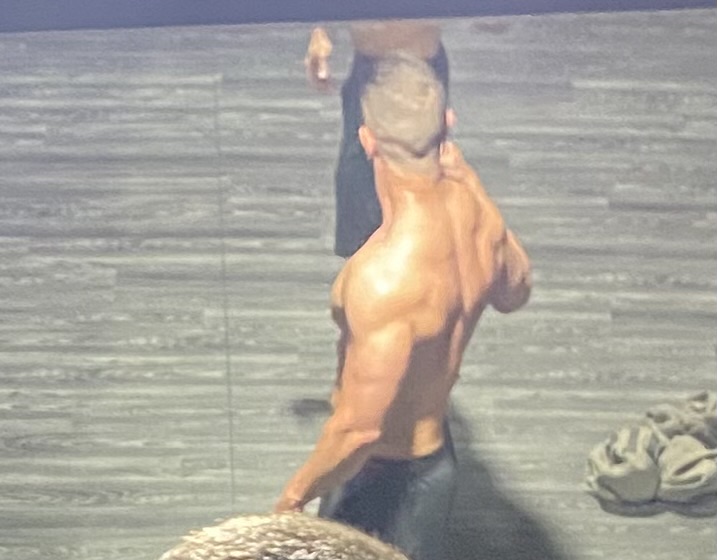
A back view from August 13rd.

This isn’t something that could be followed for a long time. For me, four weeks seems to be the sweet spot. Because I have the time, I get into this kick where I always have to train and view any downtime as an opportunity to get some form of training in. The novelty starts to wear off after four weeks, and then the last few weeks before school I go into a more normal routine.

This is just something that works for me and I finally decided to document what I do over the summer. I go through a ramping up period that started in April this year. April and early May was about getting into a routine and picking up where I left off earlier in the year. Then, as the weather really starts getting nice around late May, I start kicking things up by increasing the amount I train each week and incorporating two lifts on Saturdays.

The Summer Sprint started on July 10 and ended on August 4, when I went to the Super Coach Conference in Virginia.

WEEK 1

I gave myself a week off after returning from vacation, so this would be my first week training in roughly two weeks. The plan was to train daily, so I’d be ready to increase the workload next week. For the lifts, I kept the weight conservative.

8 Sessions – 4 Lifting, 2 Sprinting, 2 Cardio

Monday, July 10: (194) Heavy Upper Body lift

Tuesday, July 11: (193.8) Speed – Tempo Runs, Lower Body lift

Wednesday, July 12: (193.6) Cardio – Elliptical 60 minutes

Thursday, July 13: (191) Lower Body Lift

Friday, July 14: (194) Day Off

Saturday, July 15: (197.6) Running 8×100 yards, Lower Body Lift

Sunday, July 16: (194.6) Cardio – Elliptical 60 minutes

WEEK 2

By Sunday, the itch I get every summer to ramp up the training was coming back. I knew I was ready to attack the summer program hard. I’ve heard people talk about doing cardio twice per day in the past and figured I’d give it a shot myself. I chose the elliptical for cardio because it doesn’t really beat me up like jogging does and would make it easier to try for this.

The twice per day cardio experiment ended on Friday. My quads were getting pretty toasted after doing the elliptical for two hours per day. I don’t really cruise on the elliptical. Since it counts strides taken, I always try to see how far above 10,000 strides I can get in the hour and usually aim for around 18,000 strides every 10 minutes. I was also increasing the resistance and incline each session. For one session, the elliptical isn’t too bad, but twice daily was rough.

15 Sessions – 9 Cardio, 6 Lifting

Monday, July 17: (194.4) 2 Cardio – Elliptical 60 minutes each, Upper Body Lift, Lower Body Lift

Tuesday, July 18: (192.6) 2 Cardio – Elliptical 60 minutes each, Upper Body Lift

Wednesday, July 19: (192.2) 2 Cardio – Elliptical 60 minutes each

Thursday, July 20: (190.6) 2 Cardio – Elliptical 60 minutes each, Upper Body Lift

Friday, July 21: (190.2) Cardio 60 minutes, Lower Body Lift

Saturday, July 22: (194) Upper Body Lift

Sunday, July 23: (198.2) Day Off

WEEK 3

For Monday and Tuesday, I split up my day by getting a lift at home and then going to the gym for cardio at night. On Saturday, I did a lower body sled session where I did five forward pushes, five duck walks, four lateral drags each side and four backwards hamstring walks. Each set is 20 yards long. Carbs are high for the whole week, but mostly coming from fruit.

8 Sessions – 5 Lifting, 3 Cardio

Monday, July 24: (197.4) Lower Body Lift, Cardio – Elliptical 60 minutes

Tuesday, July 25: (190.4) Upper Body Lift, Cardio – Elliptical 60 minutes

Wednesday, July 26: (188.8) Cardio – Elliptical 60 minutes

Thursday, July 27: (190.4) Upper Body Lift

Friday, July 28: (192) Day Off

Saturday, July 29: (193.8) Lower Body Sled, Upper Body Lift

Sunday, July 30: (192.1) Day Off

WEEK 4

I’m trying to push through, but I can see that itch I had a few weeks ago is starting to fade. I was going to do one more week of the Summer Sprint, but realized it was best to cap it on Friday. Once I returned from the conference, I went with a more traditional lifting schedule.

10 Sessions – 6 Lifting, 4 Cardio

Monday, July 31: (191.3) Lower Body Lift, 2 Cardio – Elliptical 60 minutes each

Tuesday, August 1: (189.6) 2 Upper Body Lifts, Cardio – Elliptical 60 minutes

Wednesday, August 2: (188.6) Day Off

Thursday, August 3: (187) Lower Body Lift, Cardio – Elliptical 60 minutes, Lower Body Sled

Friday, August 4: (185.6) Upper Body Lift

TOTAL: 21 Lifting, 18 Cardio, 2 Sprinting

Phase 1 – Start Small and be Patient

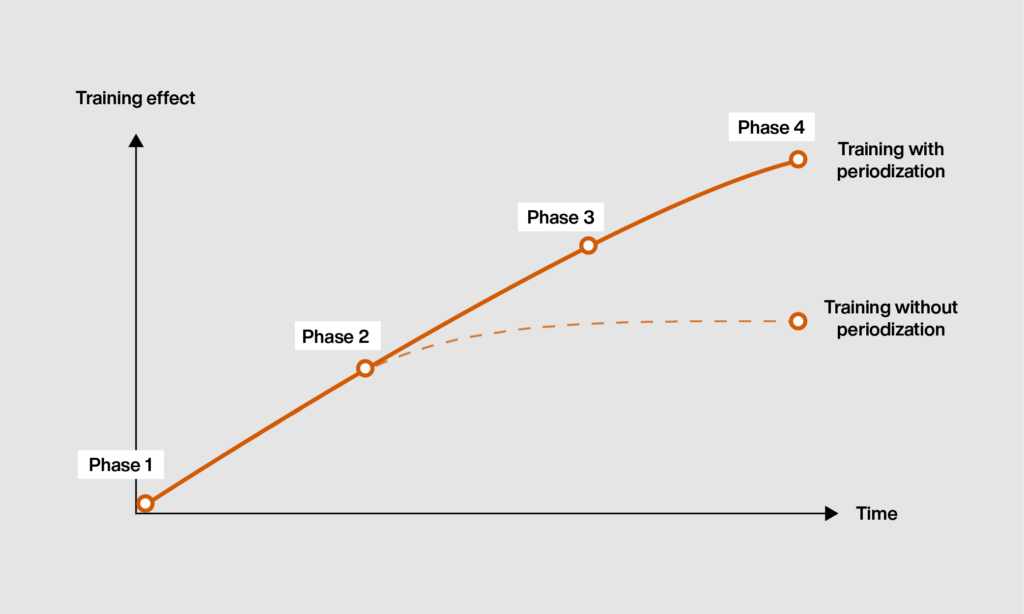
Due to some set backs, we are back in Phase 1 heading into April. I believe this can be applied to many different training goals, but I’m looking at this through the lens of weight loss and improving body composition.

When I’m starting one of these cycles, I do two things. First, I look back to what I’ve done in years past that’s worked. Then, I try to plan ahead and map things out. These are going to sync together.

Here’s how they go together: The goal of the first phase of a program is gradually build up the body’s tolerance to exercise so you can do more and better work down the road. Instead of trying to conquer your goal in one month, you want to earn daily and weekly wins by training consistently and doing what you need to do to set yourself up for future success.

I tend to over-stress the small details, especially early on, only to realize at the end of the program that it didn’t really matter. It doesn’t matter if I take it easy in the first week and don’t do that last set on an accessory exercise because I’m tired. All that matters is that I stack up the daily W’s by lifting consistently and listen to my body to build momentum. I don’t need to lose 10 pounds in the first month. The weight will come off if I follow the plan.

I go through the same thought process every year and wind up making the same mistake because I want things to go perfectly. What usually happens for me is it takes about two-to-three weeks for me to get to my regular numbers on my main lifts and then I’m ready to start really taking off.

This leads me to the next part of my thought process, which is planning ahead. I have to set myself up for June, then, after a short break, July and August, which are my hardest training months. July and August are where I’ll ramp up the intensity because I’m off of school. I give myself two body composition checkpoints, end of June and end of August.

That means the first month is about “building the foundation”. I’m going to make another post on this because I feel like the term is used by people and have no idea what it actually means. In my case, it means I have to make sure I ramp up properly for June because the training will be hard, but I’ll also still be training late because of work. With this in mind, I have to make sure I’m smart about this and not do too much too soon because then I’ll burn out in June, like I did last year.

Building the foundation for me is about slowly increasing the sets and reps for each exercise so my body adapts and my muscles, tendons and ligaments are prepared to handle the harder work that’s coming down the road. If I do this properly, my body will be able to better handle the summer blitz that’s coming.

As of right now, I’m down to 197 pounds on the nose and would like to get to just under 185 by the end of June. Right now, I’m not too focused on weight loss, but on getting my body right for May and June.

………………………………………………

Why are we starting Phase 1 in April, when it was suppose to start in January? Well, to recap, January started off great. I’m usually terrible in the winter months, but the first three weeks I was hitting good numbers and consistent. I appeared to be ahead of schedule, but the pace was too fast and I started realizing it wasn’t going to last.

The program I was running was great, but it’s more of a summer program for me than one I should be doing in the winter when I’m training late at night. So, I decided to that and am hoping to hop back on it in June. I got to the middle of the program where I had to do 10 sets of squats and deadlifts per week (six heavy sets, four repetition sets split over two days) and it just became too much to keep up with.

I got ahead of myself and paid the price. I wound up burning out, getting discouraged because I couldn’t keep the pace and February became a wash. I got sick in March and only started slowly getting back into a routine. Nagging injuries in the elbow, knee and shoulder told me I need to take a step back and slow things down.

Looking Back at 2022 and Ahead to 2023

One of my goals for this year is to write more. My goal is to post at least once per month. An easy way to keep me to it is to actually write about what I’m going to do with my own training this year. I came up with the idea last year, but didn’t follow through on the writing part. This post was in my head for a couple of months, so I figured the new year was a good time to finally get it typed up.

What I’m looking to do this year is really build off of how I trained last year. In order to fully understand that, first, I’m going to recap how last year went.

2022

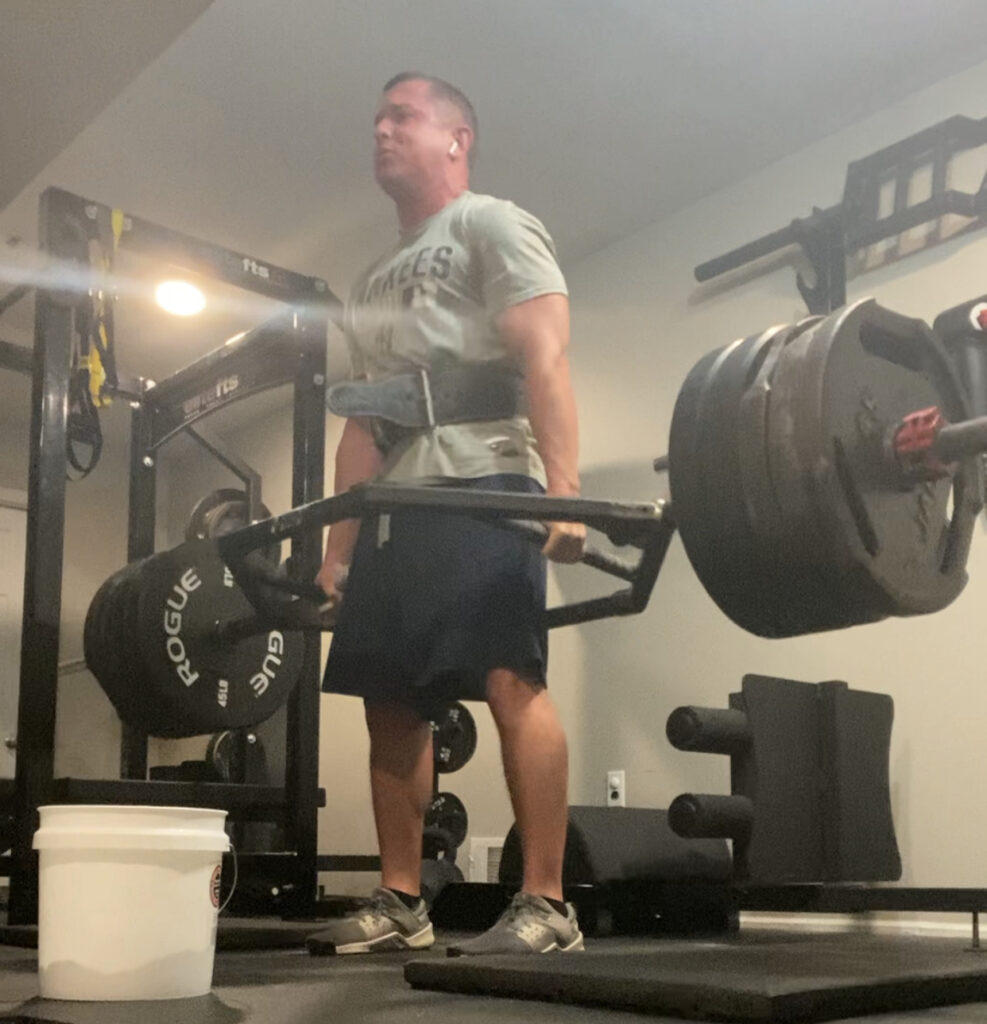
Trap-bar deadlifting 510 pounds for two reps on August 7, 2022.

The goal for 2022 was to actually enter the summer in-shape. Like I said in the post last year, I’ve had so much going on most of the year that my own training was never really a focus until the summer. My own training for the year would go: two-to-three months of good-to-decent training in the spring and fall, train six-days per week over the summer and the winter was on-and-off, at best.

I made the commitment in late February to be more consistent throughout the year and, for the most part, I was successful. 2022 was the most productive year of training I’ve ever had. In total, I logged 138 sessions, which was 36 more than I did the previous year. My strength also improved. I didn’t do any testing prior to started, but I trap-bar deadlifted 510 pounds for two reps, which was 10 pounds more than my previous one-rep-max on a straight bar. I did switch to a trap bar so I could lift heavy without using a mixed grip, but the Rogue TB 1 2.0 trap bar is so much tougher than a traditional trap bar. It’s just thick, low handles and feels like hell when you’re pushing weight. I also did the lift with one mat. Last year by best was 420 pounds for 10 reps, but off of two mats. I never attempted more than 440 pounds for three reps.

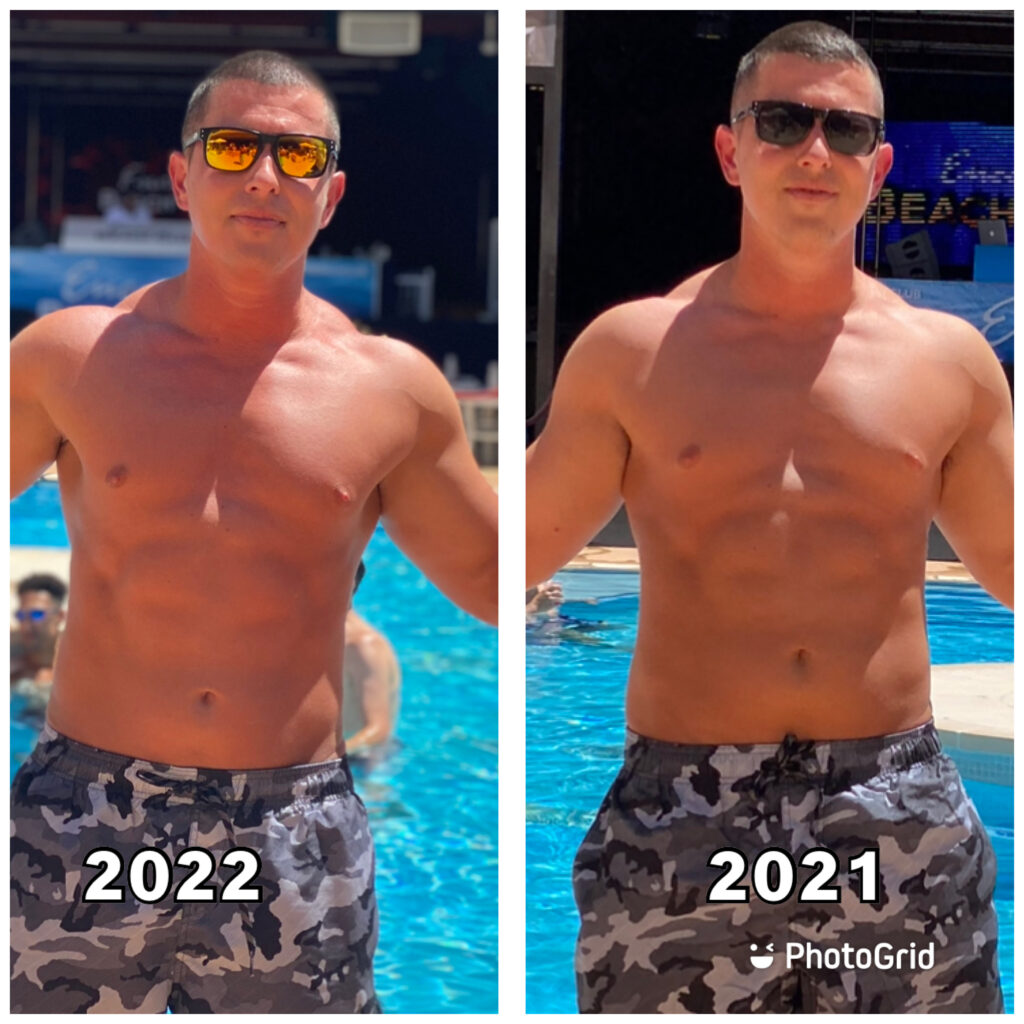
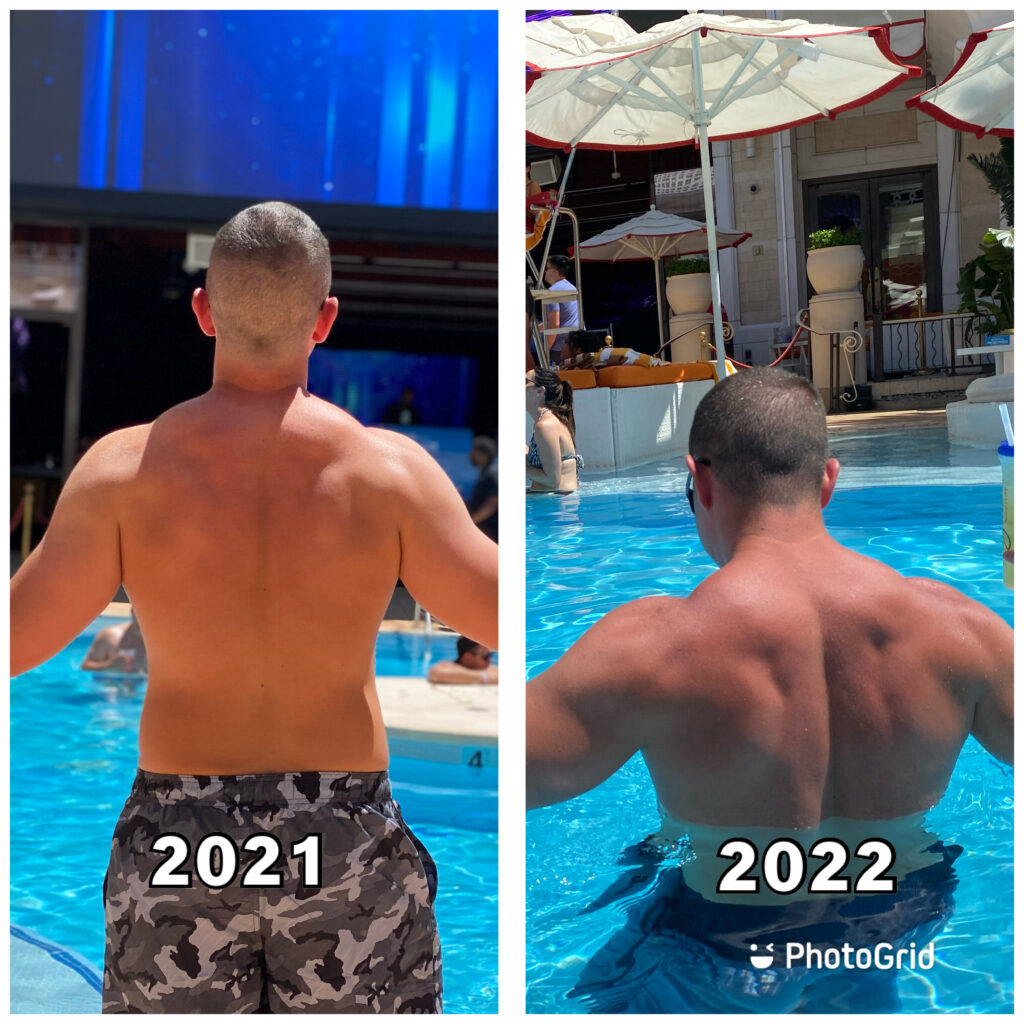
Physique wise, even though I didn’t reach the goal weight or body fat percentage I set out for, I was happy with where I ended up by the end of the summer. I finished the summer at 184.8 pounds, about two pounds lighter than I was at the same time last year, but looked better. The stomach looked tighter, the spare tire on the sides was less, the arms were bigger and the back was thicker and more pronounced. Last year I did a full-on sprint to lose 20 pounds in 39 days so the weight-gain rebound happened quicker. In 2022, I noticed it happened much slower and I looked better at higher weights than I did in previous years. Go figure, right? The “Before and After” photos are both from Encore Beach Club in Las Vegas because when it comes to how you look with your shirt off, that’s where it matters. I wore the same trunks, too. I wish the lighting was better there.

After vacation training was going well and I actually hit my 102nd workout, which was the amount I did in 2020, on August 15. That was awesome at the time, but the problem became I only trained 36 more times in the last three-and-a-half months, which is roughly nine sessions per month. Things slowed down around November. First I was feeling run down so took some time off, then had my birthday and was eating garbage. Two weeks after my birthday is Thanksgiving, so I went into cruise control and that’s never good for me. I tried to get back on the wagon in December, but sprained my pinky pretty bad to where I thought it was broken. I could barely move my pinky and now we are looking at a month where I was off track.

Add in that it’s the winter time and I started seeing where this was heading. The pinky is still swollen today, but I had to get back into my groove. I needed to turn things around or else this endless cycle of excuses and laziness will continue. Now let’s move forward.

2023

I’m not one of those “training is therapy” type of people who post on Instagram how they are releasing demons or whatever else they say online. But, I will tell you that there’s two versions of me. When I’m training and following my diet plan, I’m a way more productive person and much more positive. When I’m not training, each week feels like one continuously long day of getting nothing accomplished.

I saw what long-term consistency did for me last year and I want to build off of that. The goal is to reach 200 sessions for the year. This will ensure I’m training consistently throughout the year. I know there’s people out there who talk about moderation and not having to be on a plan all the time and, while I believe those are good rules to follow, they just don’t apply to me. I can’t freestyle it in the gym and train and eat without a plan. I need goals to reach and have to have something to accomplish each day in order for me to continue to push. I’ve tried the other way, but it never works.

I have the programs I’m going to run laid out for the next nine months. I’m going to finish Christian Thibaudeau’s “Get Jacked…Fast!” program, move on to his HSS-100 program then hit the SBOAT program over the summer that Justin Kavanaugh wrote for me in 2017. Fortunately, I didn’t wait until the ball dropped to start training again. I started working out consistently again in the middle of December and am starting the year in Week 4 of my program. My finger is still pretty swollen and I can’t fully bend it, but I could only take so much time off. I can still do all of the things I want in the gym, with some modifications.

I’ve thought about writing this post for a few months and was going to post it a couple of weeks ago. The reason I didn’t was because of the holiday season. While I have been training and eating well for the most part, there were too many family days filled with food to really start dieting the way I wanted to. My weight bounced around, but I’m starting the year at 201.6. This seems to be the weight I start most of these type of programs at, but, thanks to the work I did last year, I look much better at this weight than I did in previous years. A 24-hour fast will knock it down to around 197.

In terms of goals, they’re mostly physique related. The only strength goal I have is to get my bench press into the 300s. I’ve never had a great bench. Ever since I hit a 500-pound deadlift in 2017, I don’t really have any strength goals. Physique wise, I’d like to get to a weight and body-fat percentage where I have a six-pack and can lose the pouch that doesn’t want to leave me. I don’t know what exact weight that is, but I just want my body-fat percentage to be close to 10-to-12 percent without significant decreases in strength. I can’t give you an exact number, but you’ll know what it looks like when you see it.

Shooting for these physique goals allows me to do everything else I want to do better. When I’m at a lighter weight, I just feel so much better. That sweet spot is usually in the low 180s where I still have most of my strength and move much better. I’d like that to be my normal, every day weight and not something I have to shoot for every year. I need to get on top it now, because I’m only getting older.

On the nutrition side, I like to go no-carb when trying to drop weight quickly, but it’s easier to do in the summer time than during the school year. I’m going to carb-cycle and fit in one 24-hour fast per week, if possible. I’ve also been experimenting with more frequent meals, going with four-to-five meals per day, as opposed to my usual two-to-three and have felt much better.

I’ll be logging my food on MyFitness Pal as much as I can and will talk about what I’m doing nutrition wise, along with my eating plan during the monthly updates. This will make me post more and take you through my process that I go through during these programs.

Looking forward to bigger, more productive year.

The Next Six Months

The summer has always been the time where my best training takes place. It’s been the only time of the year where I have some down time and can really get after it. I’ve been able to make some good progress the past few summers.

Last year I was up against it, but still managed to lose 20 pounds in a little more than a month. I was happy with the progress, but left the summer with the same questions and thoughts that come into my mind at the end of every summer.

“Imagine if I had another month.”

“What progress could I have made if I came into the summer in better shape?”

“I’d love to see how things would play out if I had a long term plan to go along with this intensity.”

Training wise, the summer is a grind – in a good way. The frequency and intensity are through the roof. The only problem is the summer makes up two months of the year. That’s not enough to sustain any progress. So, what winds up happening is I go through this endless cycle of going from Point A to Point B. I say that I’ll try to maintain and keep things going, but life got in the way.

The past several years were tough. After summer, I was working two jobs, going to grad school at night and writing papers. That didn’t leave much time for training. After I graduated in May 2019, I had to try and secure a full-time teaching position. I worked each year, but with the pandemic, I found myself wondering where I’d be working in September the past three years. Because of all this, my own training got put to the side. I worked out, but the consistency wasn’t there and the intensity was certainly lacking.

The good news is I finally secured a full-time teaching position last September. This gave me stability and one less thing to worry about. After spending a couple of months getting acclimated, I started thinking about my own training. I thought about the conversation I always have with myself at the end of the summer and decided it’s time to take action.

Personally, I need a plan and goals to get into a training program. I can’t just wing it like other people. Of course, I make changes on the fly, but, for the most part, I need most of it mapped out.

That brings me to this post. There’s six months until the end of August and I want to go over what my plans are training wise.

This program is about body composition and increasing strength. I know they say you can’t get stronger while losing weight, but I’ve found that to be not true. There’s very few things I say with authority, but I’ve gone through this process to know that it isn’t true.

For me, my issue has always been losing weight. I’m one of those people who gain weight just by looking at a cookie and cakes. When I weighed myself this morning, I was 207 pounds with a body-fat percentage of 22% . I was out with friends and ate, so I’m going to fast today and that will bring me down to what my real starting weight is.

The weight I’d actually like to be at depends. It really depends on how I look. Personally, I’d like to be at 180-182 pound range by the end of school (June 28) and 175 pounds by the end of August. I feel pretty good and limber when I’m in the low to mid 180’s. I’m using the hand-held body-fat measurement device so I don’t know how accurate it is, but I’d like to be under 15% by June 28 and under 12% by the end of August. Even when I get pretty lean, I still have that little pouch at the bottom of my stomach and just want to get rid of that. So, whatever weight and percentage gets rid of that, I’m good.

Strength wise, my goals have changed. Once I hit a 500-pound deadlift in August of 2017, I haven’t been so concerned about my one-rep max. I’ve switched over to the Rogue TB-1 Trap Bar 2.0 and love it. I’ve been going for more higher-rep goals because I don’t like doing them, but feel good after doing them. My best from last year was 420×10 and I’d like to top that. I’ve never run a 40-yard dash in under five seconds and want to crack that barrier. For my upper body, I’d like to be able to get to 15 pull-ups and beat my previous bench press one-rep max of 275 pounds. I hit 275 in 2019 and haven’t attempted it since.

The program I’ll be running is the HSS-100 by Christian Thibaudeau. I love reading Christian’s work and found out about this program after talking to Justin Kavanaugh. I looked into it and started running it in 2020 and the splits work out perfectly for me during the school year. I’ll be lifting four days per week and modify it as I go along. There’s four phases and I add in his Chest Specialization phase in the second month. This gives me five phases of training, each one being four weeks long. I know this doesn’t add up to six months, but considerations need to be taken for seminar trips, possibly getting sick and weeks where work picks up.

Usually, when I’m trying to lose weight quickly I’ll go with a low-carb approach. However, since I’m starting this while the school year is still going on, I’ll need carbs. I’m going to try and slow cook things a bit by using carb cycling and giving myself one 24-hour fast per week.

This is my first time going through a five-six month plan and am looking forward to seeing how it all plays out.

Another Challenge is Just Another Opportunity for Nick Mayhugh

Going to go back a bit to August 2020. Justin Kavanaugh invited me down to Virginia to see what he had going on training wise and, honestly, just to get out of the house. At the time, this was the first normal day I had in a while. It was a hot, humid morning made even warmer by the heat radiating off of the turf. One of those days where you sweat without even moving.

I enjoy the summer heat, so it wasn’t much of an issue and it was just great to be in a positive atmosphere again. Behind me were some high school and college athletes training and to the left of me Kav was going over some things with three NFL hopefuls. My job was to take videos of Nick Mayhugh running his sprints and showing him the footage after each run.

This is how I do things with my athletes. I’ll take some footage and review it with them so they can see what they’re doing right and what they need to work on. Things were different this time because I just took a step back and listened to Nick break down each stride. I’d chime in if I saw something, but didn’t really have to do that more than once or twice. He was so dialed in, rewinding the video and noting any tiny change he had to make.

What’s great about going down to Virginia and working with Kav is pretty much all of his athletes are like this. They are so hyper-focused that they see things that most coaches don’t even see. This is why I always leave there rejuvenated and excited because you see what this higher level of coaching and athletics entails and makes you want to reach it.

Nick’s case is unique though. Nick was getting ready to train for the Paralympic Games in Tokyo. He will be running in the 100-meter, 200-meter, 400-meter and 4×100-meter relay. The prelim heats for the 100-meter begin on Thursday at 10:56 p.m and the events can be seen on NBC, NBCSN, Peacock TV and other supported streaming services.

What makes Nick’s situation unique is that he hasn’t always been a track athlete. You wouldn’t know it if you had watched him train for track and listened to him break down all of the tiny nuances of sprinting. He’s actually an accomplished soccer player who played four years at Radford University and was the 2019 US Soccer Player of the Year with a Disability. He scored eight goals in leading Team USA to its’ first international medal in 7-a-side in 2019.

“It’s been very hard because I had to learn all the small technical things about being a sprinter,” Mayhugh said last year. “I was used to running more of a cross-country style for 90 minutes and only having to sprint for 10-to-20 yards. In soccer, you’re not running 100 meters straight because you’re either cutting or turning.

“I train here everyday with Kav and work with a bunch of athletes who are all at a high level and see that next level of commitment and determination. It’s been a humbling experience to learn about the amount of training it takes and all the things I need to learn.”

Like most successful athletes at that level, Nick is his own hardest critic. He’s so laser-focused on all of the things he needs to improve on to get ready that it’s hard to see how far he’s come. I’ve met Nick before and watched him train a few times. Before August, I was watching him work on his block starts at the Sport and Speed Institute while Kav was also working with his NFL Combine Class.
Even after seeing him a few times, I still had no idea what his disability was. It was undetectable by watching him train. It wasn’t until I finally asked him after his session in August when I found out he was diagnosed with Cerebral Palsy when he was 14. He will have a T37 classification in the Paralympic Games.

He said ever since he could remember he always had a numb feeling on the entire left side of his body. There was a lack of coordination, motor and nerve function in his left side and he couldn’t feel his left foot contract.

Mayhugh (14, left) playing for Team USA.

“I don’t really have control of the digits in my left hand and I couldn’t really focus on cycling my legs or kicking the ball,” Mayhugh said. “Anything physically, I have a cap on my left side to a certain extent. It was really frustrating when I was younger because I was like ‘why can’t I tie my shoes like everyone else?’ or ‘why can’t I use my left leg in soccer?’ It was always my normal and I always compensated and adjusted so I could play.

“It wasn’t until I accepted and understood my disability that I took a break from putting all of that pressure on myself and doing all these extra workouts and training.”

Nick worked brutally hard to overcome his disability, even at a young age. He described a time where he’d go to practice and the coach put the team into positional drills. There was extra pressure on Nick because the coach said if he used his right foot, the team would have to run. He left every practice devastated because his team had to run because he couldn’t do certain things with his left foot.

“I trained everyday with my brother, Thomas, and he would set up all these cone drills so I could fix it,” Nick said. “I’d cry after practice and then go through all these drills with just my left foot to teach myself the muscle memory and motor function. It was a very frustrating process, but I wouldn’t be the man I am without all of that. I’ve had a chip on my shoulder my entire life.

“I had to work 100 times harder than everybody because of my disability. I didn’t fully understand it when I was younger, but I knew I’d do whatever it took to outwork every athlete I played against.”

“A lot of people and doctors that I tell and have worked with say that to the untrained medical eye you’d never be able to tell that I have a disability,” Nick said. “Up until I was 21 and joined the national team, no one knew. No one knew in college. When the story eventually came out, I was stubborn and didn’t want to talk about it, but I eventually opened up because it’s who I am. I got a lot of emails and texts afterwards from people that couldn’t believe it.”

Nick’s brother, Thomas, has been with him every step of the way. Nick started playing soccer when he was 4 years old and said he did so because he wanted to be like his brother. Thomas was there to run Nick through all of the extra drills to help make him the soccer player he’s become. Thomas, a former soccer player, owner of Mayhugh Athletic and bucket-hat aficionado, has also coached and helped prep Nick for his run in Tokyo.
“Training Nick has been a blessing to be a part of and an invaluable learning experience, thanks to Kav,” Thomas said. “Compartmentalizing being a brother and a coach is something you can’t teach and takes intentional practice. It’s something I may never truly master. But I do feel it has been what he has needed through the past year and to get to where he is. He’s coachable and he gets it and he understands and appreciates the difference between where we are on the track and in the gym versus not. That’s what’s making it work.”
Most guys grow up with the dream of playing professional sports. After everything Nick went through his entire life through college, he finally achieved his dream. Everything he worked for paid off and he had the contract in front of him. All he had to do was sign and he would be a full-time member of Team USA soccer.

But, he decided to pass it up for something he didn’t even know existed. The head director of Team USA Paralympics Track and Field actually reached out to him and said they were interested. He ran well at the time trials in 2019 and saw that this was a real possibility. This decision to put soccer on the back burner was very hard, Mayhugh said, but this opportunity was too good to pass up.

“I didn’t even know the Paralympics were a thing,” Mayhugh said. “I had no idea this world even existed. I’ve gone this far with soccer and was kind of interested in what other sports I could pursue. It was frustrating to turn down that contract because that was my dream. My window to run track is much smaller than my window to play soccer so I wanted to take advantage of that opportunity.

“I know these past three years with the national soccer team we’ve been able to do some incredible things and have unfinished business. But, hopefully I’ll be able to pick back up after Tokyo. It was a very hard, frustrating decision, but that’s what life’s about. Nothing ever comes easy.”

Just take a second to break down this decision. First, he had to put his dream of playing soccer on hold. This was something he worked excruciating hard for his entire life and went through way more obstacles than normal. Now, he had to start from scratch again and learn an entirely new sport.

Nothing has ever come easy in sport for Nick, but that seems to be the way he needs it to be. Another challenge means another opportunity, in his mind. Now, starting Thursday, he will become the first athlete selected to Team USA to complete as both a soccer and track athlete.

Home Gym 2.0

The new Home Gym set up as of August 2020.

Sometimes things don’t always go according to the plan. The timeline for the growth of my home gym accelerated from a multi-year plan to a five-month plan.

When my shipment came from elitefts in March, the plan was to use the basement as a way to get my big three lifts (squat, bench press, deadlift) in with little interruption. Then, since I have little time to train while coaching people at the gym, I would use my down time there and get my accessory work done.

However, the pandemic has changed a lot of things. While watching TV in May, I heard gyms wouldn’t be a part of the Phase 4 opening and wasn’t sure if they would open at all this year. I didn’t know if I would be able to train anybody again this year or even be able to get a legitimate workout in myself.

About a week or two after, Justin Kavanaugh called me and told me he was giving away equipment from his gym. He wound up giving me a 45-degree back extension, a calf raise machine, a pair of kettlebells, some chains and a battling rope. He also gave me a pair of cables that I could attach to my rack to do all sorts of plate loaded exercises to mimic some of the machines. With the small space I had created, I didn’t have enough room for all of this and decided to expand. I always wanted a back extension because it’s one of my favorite pieces of equipment. Once I got it, I decided to go in and start building the home gym of my dreams.

Titan Fitness Multi-Grip Bar and Rogue TB-1 Trap Bar 2.0 hanging on the bar rack.

To go about this expansion, there were two questions I had to consider: What would I need to train people the way I want and what would be optimal for my own training? I searched everywhere on the internet from Facebook Marketplace to eBay to Craigslist. My first two hits came from FB Marketplace where I found the Titan Fitness Multi-Grip Bar and Rogue TB-1 Trap Bar 2.0. I loved using the Rogue trap bar at the gym because of its thick handle and it was a lot tougher to use than the traditional trap bars. The numbers I pulled on the Rogue trap bar closely resembled what I would pull with a regular barbell.

Then, I went to Rogue’s website and ordered some mats for added floor protection during deadlifts and a band rack. I got the square mats they use with their deadlift platforms.The place was starting to take shape and I had about 80% of what I wanted. The big thing I was missing was dumbbells. I could workout fine without them, but figured they would be a big piece if I planned on training anyone else. I couldn’t get a whole rack of dumbbells and needed to look into finding PowerBlocks.

PowerBlocks Elite EXP up to 90 pounds and Rogue mats.

Finding a pair of PowerBlocks and getting the right expansion sets was a chore. It didn’t help that I was looking for, perhaps, the hottest commodity during a pandemic where all the gyms were closed. Finding them was easy, the hard part was getting them at a somewhat reasonable price. I saw the PowerBlocks that go up to 24 pounds going for at least $400 and the the ones that go up to 50 pounds were being priced anywhere from $800 to $1,000. I’m desperate, but not that desperate.

Fortunately, I was able to find a pair at a reasonable price in New Jersey and got the PowerBlocks 50 Elite EXP. These go up to 50 pounds and then found the Stage 3 Expansion kit (70-90 pounds) for a good price on eBay. All I needed was the Stage 2 Expansion kit (50-70 pounds). My first attempted at buying the kit off eBay led to me getting the wrong model (which I later sold on FB Marketplace). The Stage 2 kit was nowhere to be found and took a month of searching before I finally found it. This kit I had to spend a bit to get because they were so rare.

In between all this, I added a decline bench press for my own personal use and felt I had about 95% of what I wanted. I had a good enough home gym where I felt I could do almost any exercise I’d do in the gym. I got a little greedy and decided to make the last two purchases to finish the job.

elitefts Floor Glute Ham Raise

First, I got a bar rack from elitefts to help with the clutter. The only piece I wanted to add was a glute ham raise (GHR), which is probably my favorite lower body exercise. They weren’t hard to find. The issue I had was space and height. My gym was getting a little crowded and my room isn’t tall enough to have people perform the exercise on a standard GHR.

I needed something smaller and the Rogue Echo GHR was sold out. After doing some searching, I found that elitefts made a home model that just came with the main pieces and had wheels. I feel like elitefts has a piece of equipment for every situation. I put in the call to Matt Goodwin and he set me up with my dream piece of equipment, outside of the squat rack.

I’d like to say I’m done, but I’m sure there will be more purchases in the future. But, hypothetically, if I didn’t purchase another piece of equipment for the rest of my life, I’d say I’ve got my version of the ultimate home gym set up. This set up has gone far beyond what I had in mind when I started this all in February.

« Older posts Newer posts »